






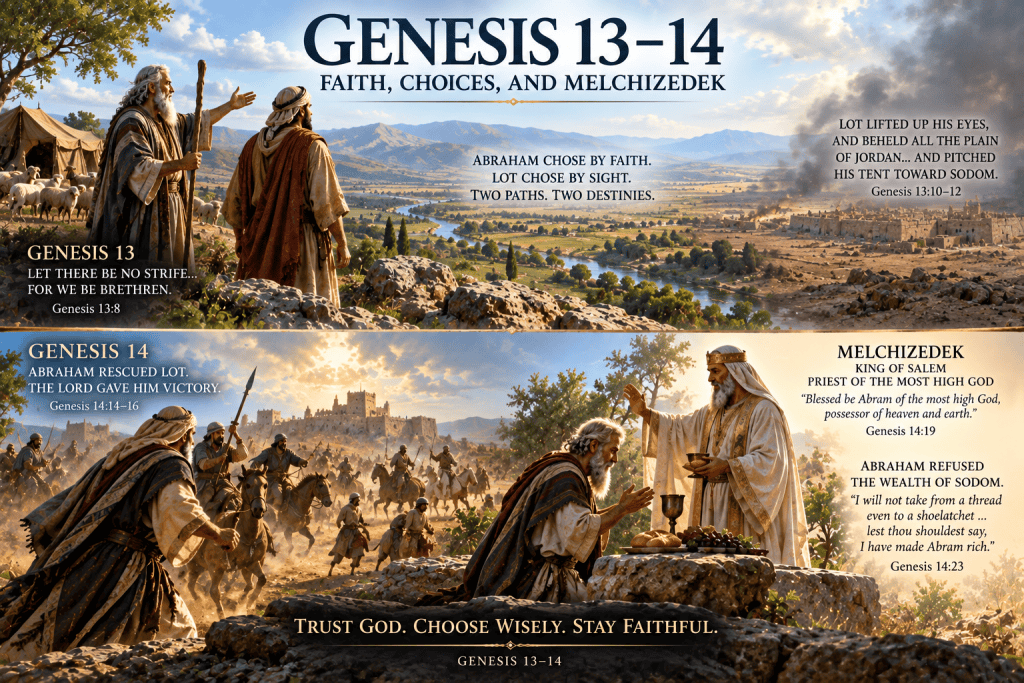
Genesis 13–14 — Abraham and Lot: Faith, Choices, and Melchizedek
Key Scriptures: Genesis 13:1–18; Genesis 14:1–24; Hebrews 7:1–10; Psalm 110:4; 2 Peter 2:7–8
“And Abram said unto Lot, Let there be no strife, I pray thee, between me and thee… for we be brethren.” — Genesis 13:8
Genesis 12 introduced us to Abram as a man learning to walk by faith.
God called him from his homeland and promised to make him a great nation. Abram obeyed and traveled to Canaan.
However, Abram’s faith faltered when famine came.
Instead of trusting God, he went to Egypt and allowed fear to control his decisions. As a result, his testimony suffered before Pharaoh.
Nevertheless, God remained faithful.
Genesis 13–14 shows Abram returning to the land, resolving conflict with Lot, rescuing his nephew from invading kings, meeting the mysterious Melchizedek, and refusing wealth that could compromise his testimony.
Through these events, Abram continues learning a fundamental lesson:
Faith trusts God enough to let Him provide.
Abram Returned from Egypt
Genesis 13 begins:
“And Abram went up out of Egypt, he, and his wife, and all that he had.” — Genesis 13:1
Abram had made mistakes in Egypt.
However, his failure was not the end of his journey with God.
He returned to Canaan.
More specifically, he returned to the place where he had previously built an altar.
Genesis 13:4 says:
“Unto the place of the altar, which he had made there at the first: and there Abram called on the name of the LORD.”
That is significant.
Abram returned to worship.
He had wandered.
Now he came back.
This is one of the great blessings of God’s grace.
Failure does not have to become our permanent address.
When we wander, we can return.
When we sin, we can repent.
When our faith falters, we can call upon the Lord again.
Back to the Altar
Abram had built an altar before going to Egypt.
Interestingly, Scripture does not record Abram building an altar in Egypt.
Instead, when he returned to Canaan, he went back to the place of worship.
There is an important lesson here.
Whenever we discover that we have wandered spiritually, the answer is not to keep moving farther away.
Return to:
- God.
- prayer.
- Scripture.
- worship.
- obedience.
In other words, go back to the altar.
Prosperity Created a Problem
Abram and Lot had become wealthy.
Genesis 13:2 says:
“And Abram was very rich in cattle, in silver, and in gold.”
Lot also possessed flocks, herds, and tents.
At first, that sounds entirely positive.
However, prosperity created a new problem.
There was not enough grazing land for both households.
Therefore:
“There was a strife between the herdmen of Abram’s cattle and the herdmen of Lot’s cattle.” — Genesis 13:7
Sometimes our greatest spiritual tests come not during poverty but during prosperity.
We usually think trouble tests our faith.
Certainly, it does.
However, success tests us too.
What will we do when we have more?
Will:
- possessions create conflict?
- prosperity produce pride?
- we begin trusting what we possess rather than the God who provided it?
Abram now faced that test.
“For We Be Brethren”
Abram approached Lot and said:
“Let there be no strife, I pray thee, between me and thee… for we be brethren.” — Genesis 13:8
That is a wonderful principle for God’s people.
Abram valued the relationship more than the argument.
He could have insisted upon his rights.
After all, God had promised the land to Abram, not Lot.
Abram was also the elder.
Therefore, he could reasonably have demanded first choice.
Instead, Abram sought peace.
Sometimes being right is less important than preserving a relationship.
That does not mean truth is unimportant.
Rather, it means we should not allow selfishness, possessions, or personal preferences to create unnecessary division.
Paul later writes:
“If it be possible, as much as lieth in you, live peaceably with all men.” — Romans 12:18
Abram Gave Lot the First Choice
Abram told Lot:
“Is not the whole land before thee? separate thyself, I pray thee, from me.”
Then he offered Lot the choice.
If Lot went left, Abram would go right.
But if Lot went right, Abram would go left.
Why could Abram afford to be so generous?
Because his confidence was no longer primarily in the land.
His confidence was in God.
Abram did not have to fight for the best portion.
God had already promised to care for him.
Faith frees us from the desperate need to grab everything for ourselves.
When we trust God as our provider, we can afford to be generous.
Lot Looked
Genesis 13:10 says:
“And Lot lifted up his eyes, and beheld all the plain of Jordan, that it was well watered every where.”
The land looked wonderful.
It was green, fertile, and had abundant water.
From a purely economic perspective, Lot’s choice made sense.
However, there was another fact to consider.
Genesis 13:13 says:
“But the men of Sodom were wicked and sinners before the LORD exceedingly.”
Lot evaluated the land by what he could see.
He apparently did not give enough consideration to the spiritual environment surrounding it.
That mistake would become costly.
Not Everything That Looks Good Is Good
Lot’s choice teaches us an important lesson.
Appearance is not enough.
- A decision can make financial sense and still be spiritually dangerous.
- A career may offer more money but pull us away from our family and church.
- A relationship may seem attractive but draw us away from God.
- An opportunity may promise success but require compromise.
Therefore, when making decisions, Christians should ask more than:
“What will benefit me?”
We should also ask:
“What will this choice do to my walk with God?”
Lot Pitched His Tent Toward Sodom
Genesis 13:12 gives us a small but significant detail:
“Lot dwelled in the cities of the plain, and pitched his tent toward Sodom.”
Lot did not immediately move into Sodom.
He simply moved toward it.
However, by Genesis 14, Lot is living in Sodom.
Later, Genesis 19 will find him sitting in the gate of Sodom.
That progression is worth noticing.
First, Lot looked toward Sodom.
Then he moved toward Sodom.
Next, he lived in Sodom.
Eventually, Sodom became deeply connected with his family.
Sin often works that way.
We rarely wake up one morning and decide to ruin our lives.
Instead, compromise usually begins with small movements in the wrong direction.
Therefore, we should pay attention not only to where we are but also to which direction we are moving.
Abram Let God Choose
After Lot departed, God spoke to Abram.
“Lift up now thine eyes, and look from the place where thou art.” — Genesis 13:14
There is a beautiful contrast here.
Lot lifted up his eyes and chose what looked best.
Afterward, God told Abram to lift up his eyes and see what God would give him.
Lot chose by sight.
Abram received by promise.
God told Abram:
“All the land which thou seest, to thee will I give it, and to thy seed for ever.” — Genesis 13:15
Abram had surrendered first choice.
Nevertheless, he lost nothing God intended for him.
That is an important principle:
You never lose by trusting God with what belongs to Him.
Abram Built Another Altar
Abram moved to the plain of Mamre near Hebron.
Then Genesis tells us:
“And built there an altar unto the LORD.” — Genesis 13:18
Again we find Abram at an altar.
Abram lived in tents.
But he built altars.
Lot moved toward a city.
Abram moved deeper into worship.
The contrast between the two men is becoming clearer.
Lot increasingly pursued what he could see.
Abram increasingly learned to trust what God had promised.
War Came to the Region
Genesis 14 changes scenes dramatically.
Several kings went to war against one another.
The details can seem complicated because Genesis names numerous kings and locations.
However, the central issue becomes clear.
Sodom and Gomorrah were defeated.
Their possessions were taken.
And:
“They took Lot, Abram’s brother’s son, who dwelt in Sodom, and his goods, and departed.” — Genesis 14:12
Lot’s choice now had consequences.
He had chosen the prosperous region around Sodom.
However, when Sodom became involved in war, Lot became involved too.
The place that promised prosperity now brought captivity.
Our choices often connect us with consequences we never anticipated.
Abram Heard About Lot
Someone escaped from the battle and told Abram what had happened.
Abram could have said:
“Lot made his choice.”
He could have reminded everyone that Lot had selected the best land for himself.
Instead, Abram acted.
Genesis 14:14 says:
“When Abram heard that his brother was taken captive, he armed his trained servants.”
Abram gathered 318 trained men from his own household and pursued the invading forces.
This tells us something about Abram’s character.
He had refused to fight with Lot over possessions.
Now he was willing to fight for Lot when Lot was in trouble.
That is a powerful picture of love.
Grace Does Not Say, “I Told You So”
Lot’s problems resulted, at least partly, from his own choices.
Nevertheless, Abram did not respond with smug satisfaction.
He rescued him.
There is a lesson here for us.
Sometimes people we love make poor decisions.
Later, those decisions bring painful consequences.
When that happens, it may be tempting to say:
“I told you so.”
However, grace asks a different question:
“How can I help?”
We should not enable destructive behavior.
Nevertheless, when someone genuinely needs rescue, love does not rejoice in being proven right.
Love seeks restoration.
Abram Rescued Lot
Abram divided his forces by night and attacked.
God gave him victory.
As a result, Abram recovered:
“All the goods, and also brought again his brother Lot, and his goods, and the women also, and the people.” — Genesis 14:16
This is a remarkable transformation.
In Genesis 12, Abram was afraid that Pharaoh might kill him.
In Genesis 14, Abram courageously pursued an army to rescue Lot.
His faith was growing.
The man who once acted from fear was learning to act from confidence.
Spiritual growth often happens gradually.
God patiently develops us through experience.
Two Kings Came to Meet Abram
After Abram returned from victory, two kings came to meet him.
They could hardly have been more different.
One was the king of Sodom.
The other was Melchizedek, king of Salem.
Abram now faced another test.
He had passed the test of conflict and courage.
Now he would face the test of success.
Sometimes victory creates temptations that defeat never could.
Melchizedek, King of Salem
Genesis 14:18 says:
“And Melchizedek king of Salem brought forth bread and wine: and he was the priest of the most high God.”
Melchizedek is one of the most fascinating figures in Genesis.
His name means king of righteousness.
He was king of Salem, a word associated with peace.
In addition, he was:
“The priest of the most high God.”
Therefore, Melchizedek was both king and priest.
He blessed Abram and said:
“Blessed be Abram of the most high God, possessor of heaven and earth.” — Genesis 14:19
Then he praised God:
“And blessed be the most high God, which hath delivered thine enemies into thy hand.” — Genesis 14:20
Melchizedek correctly identified the source of Abram’s victory.
Abram had fought.
But God had delivered.
Abram Gave Melchizedek a Tenth
Genesis 14:20 says:
“And he gave him tithes of all.”
Abram gave Melchizedek a tenth of the spoils.
This happened centuries before the Law of Moses established Israel’s tithing requirements.
Abram’s action was a voluntary acknowledgment that his victory and possessions ultimately came from God.
Worship recognizes:
Everything I have comes from God.
Therefore, giving is not merely a financial act.
It can also be an act of worship and gratitude.
Who Was Melchizedek?
Melchizedek appears briefly in Genesis 14.
Then he disappears from the Genesis narrative.
However, he appears again in Psalm 110 and receives extensive attention in Hebrews 7.
Hebrews describes Jesus as:
“A priest for ever after the order of Melchisedec.” — Hebrews 7:17
Some have suggested that Melchizedek was a pre-incarnate appearance of Christ.
Others understand him as a historical king-priest whose unusual position became a God-given picture of Christ’s greater priesthood.
Scripture does not explicitly identify Melchizedek as Christ Himself.
Therefore, we should avoid claiming more than the Bible says.
What Scripture clearly teaches is that Melchizedek’s priesthood points us toward Jesus Christ.
Jesus Is Our Greater King and Priest
Israel’s priests normally came from the tribe of Levi.
Its kings came from the line of Judah.
However, Jesus is both King and Priest.
Like Melchizedek, Christ combines those offices.
Yet Jesus is infinitely greater.
He does not merely offer bread and wine.
Jesus offers Himself.
He does not merely pronounce blessing.
Christ provides eternal salvation.
He does not serve temporarily.
Hebrews says:
“He ever liveth to make intercession for them.” — Hebrews 7:25
Melchizedek appears briefly.
Jesus remains our eternal High Priest.
The King of Sodom Made an Offer
Next came the king of Sodom.
He told Abram:
“Give me the persons, and take the goods to thyself.” — Genesis 14:21
Abram could have become even wealthier.
He had won the battle.
The spoils were available.
However, Abram refused.
He said:
“I will not take from a thread even to a shoelatchet.” — Genesis 14:23
Why?
Abram explained:
“Lest thou shouldest say, I have made Abram rich.”
Abram did not want the king of Sodom taking credit for God’s blessing.
Abram Refused Compromised Wealth
Earlier, Abram had allowed Pharaoh to enrich him under questionable circumstances.
Perhaps he had learned from that experience.
This time, he refused.
Abram would rather trust God than become indebted to Sodom.
There is an important lesson here.
Not every profitable opportunity is a good opportunity.
Money can come with strings attached.
Success can require compromise.
Therefore, believers must sometimes say:
“No.”
Not because the opportunity has no value, but because faithfulness has greater value.
The Most High God Possesses Everything
Abram described God as:
“The most high God, the possessor of heaven and earth.” — Genesis 14:22
That belief changed the way Abram viewed wealth.
If God possesses heaven and earth, Abram did not need Sodom’s riches.
His provider was greater than any king.
This is one of the great freedoms of faith.
When we believe God is our provider, we do not have to compromise ourselves for material gain.
We can trust Him.
Lot Chose Sodom; Abram Chose God
Genesis 13–14 places two paths before us.
Lot looked at the fertile plains.
Abram looked to God’s promise.
Lot moved toward Sodom.
Abram built an altar.
Lot gained a desirable location.
Then he lost everything temporarily in war.
Abram surrendered first choice.
Yet God continued blessing him.
Lot lived by sight.
Abram increasingly lived by faith.
That does not mean Abram was perfect.
He was still learning.
However, his direction was increasingly toward God.
What Genesis 13–14 Means for Us
1. Failure Does Not Have to Be Final
Abram failed in Egypt.
However, he returned to the altar.
When we wander from God, we should return.
2. Relationships Matter More Than Possessions
Abram refused to let grazing land destroy his relationship with Lot.
Therefore, we should be careful about allowing money, property, or preferences to divide us unnecessarily.
3. Faith Does Not Have to Grab the Best Deal
Abram allowed Lot to choose first because he trusted God.
Likewise, trusting God frees us to be generous.
4. Choices Should Be Spiritual as Well as Practical
Lot saw fertile land.
However, he underestimated Sodom’s spiritual danger.
Therefore, we should ask how our decisions will affect our walk with God.
5. Pay Attention to Your Direction
Lot first pitched his tent toward Sodom.
Later, he lived there.
Small compromises can become large ones.
6. Love Helps People Even After Poor Choices
Abram rescued Lot instead of saying, “I told you so.”
Grace seeks restoration.
7. Give God the Credit for Victory
Melchizedek reminded Abram that God had delivered his enemies into his hand.
Likewise, our accomplishments should lead to gratitude rather than pride.
8. Not Every Financial Opportunity Is Worth Taking
Abram refused Sodom’s wealth because he wanted God to receive the credit for his blessing.
Integrity is worth more than profit.
Look Up
Genesis 13 contains a fascinating contrast.
Lot lifted up his eyes and saw what he wanted.
Then God told Abram to lift up his eyes and see what God promised.
We face that same choice.
We can look around and ask:
“What appears best for me?”
Or we can look to God and ask:
“What would please You?”
The first approach lives by sight.
The second lives by faith.
Faith does not mean ignoring reality.
Rather, faith means seeing reality in light of God’s promises.
Choose Your Direction Carefully
Lot’s story also reminds us that direction matters.
You may not be where you eventually will be.
But you are moving somewhere.
Therefore, ask yourself:
Am I moving closer to God?
Or farther away?
Are my choices strengthening my faith?
Or weakening it?
Are the people around me encouraging me toward Christ?
Or slowly drawing me away?
Are my priorities becoming more spiritual?
Or increasingly worldly?
Lot did not move into Sodom in one dramatic step.
He moved toward it.
Therefore, choose your direction carefully.
The Better King
Genesis 14 ends with Abram standing between two kings.
The king of Sodom offered him wealth.
Melchizedek pronounced God’s blessing.
Abram rejected Sodom’s offer and honored the priest of the Most High God.
In a sense, every believer faces the same decision.
The world offers its rewards.
Christ offers something infinitely greater.
The world says:
“Take what I can give you.”
Jesus says:
“Follow Me.”
The world offers temporary treasure.
Jesus offers eternal life.
Therefore, we should remember the words of Christ:
“For where your treasure is, there will your heart be also.” — Matthew 6:21
Abram was still learning.
Nevertheless, Genesis 13–14 shows that his heart was increasingly learning where its true treasure belonged.
Not in Sodom or possessions or victory.
But in the Most High God, possessor of heaven and earth.
WIM Takeaway
Genesis 13–14 teaches us that faith trusts God enough to choose peace over possessions, spiritual health over outward prosperity, and integrity over compromised wealth. Lot chose by sight and moved toward Sodom. Abram increasingly chose by faith, built altars, rescued his nephew, honored Melchizedek, and trusted the Most High God to provide.
Questions for Reflection
- Why was Abram’s return to the altar significant after his failure in Egypt?
- What does Abram’s handling of the conflict with Lot teach us about relationships?
- Why could Abram afford to let Lot choose the land first?
- What mistake did Lot make when evaluating the plain of Jordan?
- Are there decisions in your life that look good practically but may be dangerous spiritually?
- What can Lot’s gradual movement toward Sodom teach us about compromise?
- Why did Abram rescue Lot despite Lot’s earlier selfish choice?
- What does Melchizedek teach us about giving God the credit for our victories?
- How does Melchizedek point us toward Jesus Christ?
- Why did Abram refuse the king of Sodom’s wealth?
- Is there anything you need to surrender because receiving it would compromise your testimony?
- In what direction are your present choices moving you—toward God or away from Him?
<<Back to the Book of Genesis
Dr. Alan Holden has served in pastoral ministry for more than 35 years, preaching and teaching the Bible in churches across the United States. He holds a Doctor of Ministry from Luther Rice Seminary and a Master of Divinity from The Southern Baptist Theological Seminary. Through What’s It Mean?, he seeks to help readers understand the meaning of Scripture and grow in their walk with Christ. He is currently the pastor of Lake Saunders Baptist Church in Tavares, FL.