







Genesis 12 — The Call of Abraham: Stepping Out by Faith
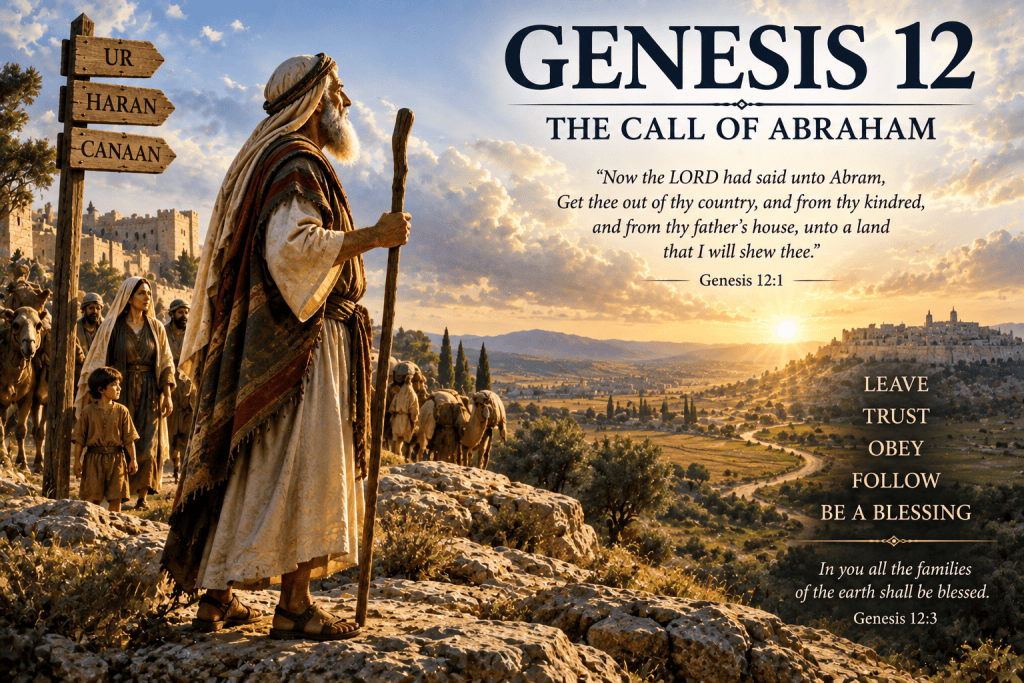
Key Scriptures: Genesis 12:1–20; Hebrews 11:8–10; Romans 4:1–5; Galatians 3:6–9; Acts 7:2–5
“Now the LORD had said unto Abram, Get thee out of thy country, and from thy kindred, and from thy father’s house, unto a land that I will shew thee.” — Genesis 12:1
Genesis 12 marks one of the great turning points in the Bible.
Chapters 1–11 deals primarily with humanity as a whole. We have seen creation, the Fall, the Flood, the nations, and the Tower of Babel.
Now the story narrows.
God calls one man.
His name is Abram.
Later, God will change his name to Abraham.
God will make a covenant with this man, create a nation through his descendants, and ultimately bring Jesus Christ into the world through his family.
Therefore, Genesis 12 is not simply the story of one man’s journey.
It is the beginning of a major new stage in God’s plan of redemption.
From Babel to Abraham
Genesis 11 and 12 present an important contrast.
At Babel, the people said:
“Let us make us a name.” — Genesis 11:4
However, God said to Abram:
“I will bless thee, and make thy name great.” — Genesis 12:2
The people of Babel tried to make themselves great.
Abram trusted God to do what He had promised.
That difference lies at the heart of faith.
Pride says:
“I will make something of myself.”
Faith says:
“I will trust God with my life.”
Therefore, Abraham’s story begins where Babel’s philosophy fails.
God Called Abram
Genesis 12 begins:
“Now the LORD had said unto Abram, Get thee out of thy country.”
God called Abram to leave several things behind.
He was to leave his:
Country.
Kindred.
Father’s house.
In other words, God was asking Abram to leave the familiar.
His:
- surroundings would change.
- relationships would change.
- security would change.
Nevertheless, God was calling him forward.
That is often how faith works.
God does not always give us the complete map before asking us to take the first step.
Sometimes He simply says:
“Follow Me.”
A Land God Would Show Him
God told Abram to go:
“Unto a land that I will shew thee.”
Notice what God did not do.
He did not:
- hand Abram a detailed itinerary.
- explain every stop along the journey.
- tell Abram everything that would happen.
Instead, Abram had to trust the One who was leading him.
Hebrews 11:8 explains:
“By faith Abraham, when he was called to go out into a place which he should after receive for an inheritance, obeyed.”
Then Hebrews adds:
“And he went out, not knowing whither he went.”
Abram did not know where the journey would end.
But he knew who had called him.
That was enough to begin.
Faith Does Not Require Knowing Everything
People often want God to explain the entire plan before we obey.
We want to know:
Where will this lead?
How long will it take?
What will it cost?
What problems will I face?
How will everything work out?
Certainly, there is nothing wrong with wise planning.
However, faith cannot always wait for complete information.
Sometimes obedience must come before understanding.
Proverbs 3:5–6 says:
“Trust in the LORD with all thine heart; and lean not unto thine own understanding.”
Faith does not mean that we understand everything.
Rather, faith means that we trust God even when we do not.
God Gave Abram a Promise
God did not merely tell Abram what to leave.
He also told Abram what He would do.
Genesis 12:2–3 contains a series of remarkable promises.
God said:
“I will make of thee a great nation.”
Then:
“I will bless thee.”
Furthermore:
“And make thy name great.”
And:
“Thou shalt be a blessing.”
God continued:
“I will bless them that bless thee, and curse him that curseth thee.”
Finally:
“In thee shall all families of the earth be blessed.”
These promises form the foundation of God’s covenant relationship with Abraham.
“I Will”
Notice who is responsible for fulfilling the promises.
Again and again God says:
“I will.”
I will:
-
-
- make your name great.
<
-
li>bless those who bless you
-
- .<
/ul>
God’s promises rest upon G
-
- od’s power.
Abram could not create a great nation by himself.
In fact, there was an obvious problem.
Abram and Sarai had no children.
Yet God promised to make a great nation from him.
Therefore, Abram would have to depend upon God to accomplish what human circumstances seemed to make impossible.
That is another important lesson about faith:
God’s promises are not limited by our limitations.
Blessed to Be a Blessing
God told Abram:
“I will bless thee… and thou shalt be a blessing.”
This teaches an important principle.
God’s blessings are not intended to stop with us.
He blesses us so that we can bless others.
For example, God may give us knowledge so that we can teach.
He may give us resources so that we can share.
God may give us experiences so that we can encourage someone facing the same struggle.
He may give us spiritual gifts so that we can serve the church.
Therefore, the right question is not merely:
“How has God blessed me?”
We should also ask:
“How can I use God’s blessings to bless someone else?”
All Families of the Earth
The final promise of Genesis 12:3 reaches far beyond Abram’s immediate family:
“In thee shall all families of the earth be blessed.”
Remember what happened in Genesis 10–11.
The nations were scattered.
Languages were confused.
Humanity divided across the earth.
Nevertheless, God had not abandoned the nations.
Instead, God chose one man through whom He would eventually bring blessing to them all.
The New Testament explains how this promise reaches its ultimate fulfillment.
Galatians 3:8 says:
“In thee shall all nations be blessed.”
Then Paul connects God’s promise to Abraham with the Gospel.
Ultimately, the blessing comes through Jesus Christ.
Therefore, Genesis 12 is already pointing us toward the Gospel.
“So Abram Departed”
Genesis 12:4 gives us Abram’s response:
“So Abram departed, as the LORD had spoken unto him.”
That sentence is simple.
But it reveals genuine faith.
God spoke.
Abram obeyed.
He did not merely agree with God’s command.
Abram acted upon it.
Likewise, biblical faith is more than intellectual agreement.
Faith:
-
-
- moves.
- obeys.
- follows.
-
James later reminds us:
“Faith without works is dead.” — James 2:20
Works do not earn salvation.
However, genuine faith produces a changed response to God.
Abram believed enough to leave home.
Abram Was Seventy-Five Years Old
Genesis tells us:
“Abram was seventy and five years old when he departed out of Haran.” — Genesis 12:4
That detail is worth noticing.
Abram was not a young man beginning adult life.
He was seventy-five.
Nevertheless, God still had a new chapter for him.
Sometimes we assume that God only calls young people to new tasks.
Scripture says otherwise.
Moses was eighty when he stood before Pharaoh.
Caleb was eighty-five when he asked for his mountain.
Abram was seventy-five when he began this great journey of faith.
Therefore, age does not disqualify us from usefulness to God.
As long as God gives us life, He can still give us opportunities to trust Him, serve Him, and bless others.
Abram Entered Canaan
Abram took Sarai, Lot, their possessions, and those with them and traveled toward Canaan.
Genesis 12:5 says:
“And into the land of Canaan they came.”
He had finally arrived in the land God promised.
However, there was a complication:
“And the Canaanite was then in the land.” — Genesis 12:6
The promised land was not empty.
God’s promise did not mean Abram would face no obstacles.
Likewise, following God does not guarantee an easy road.
Sometimes obedience takes us directly into difficulty.
The presence of opposition does not necessarily mean we have missed God’s will.
Sometimes obstacles are found right in the middle of obedience.
God Appeared to Abram
Then God spoke again:
“Unto thy seed will I give this land.” — Genesis 12:7
God confirmed His promise.
Abram responded by building an altar.
“And there builded he an altar unto the LORD, who appeared unto him.”
This becomes a repeated pattern in Abram’s life.
God speaks.
Abram responds with worship.
Then Abram moves again and builds another altar.
In fact, Genesis 12:8 says:
“And there he builded an altar unto the LORD, and called upon the name of the LORD.”
Abram was a pilgrim.
He lived in tents.
Yet wherever he went, he built altars.
That contrast is beautiful.
The tent represented his temporary home.
The altar represented his permanent God.
Tents and Altars
Abram’s life can almost be summarized by two objects:
A tent and an altar.
The tent said:
“I am only passing through.”
The altar said:
“I belong to God.”
Hebrews 11 says Abraham looked:
“For a city which hath foundations, whose builder and maker is God.” — Hebrews 11:10
Christians need that same perspective.
This world is not our final home.
Our houses are:
-
-
- temporary.
- temporary.
- temporary.
-
Even our earthly bodies are temporary.
However, our relationship with God is eternal.
Therefore, we should hold temporary things loosely and eternal things tightly.
Then Came a Famine
Everything seemed to be going well.
Abram obeyed.
He reached Canaan.
God appeared to him.
He built altars.
Then Genesis 12:10 says:
“And there was a famine in the land.”
A famine?
In the land God had led him to?
Yes.
This teaches us something important.
Obedience does not exempt us from trials.
We sometimes assume that difficulty means we have made a wrong decision.
However, Abram was in the land because he had obeyed God.
The famine still came.
Faith does not mean we never face trouble.
Instead, faith means we learn to trust God in the middle of trouble.
Abram Went Down to Egypt
Because the famine was severe, Abram traveled to Egypt.
As he approached Egypt, fear began to control him.
Sarai was beautiful.
Abram feared the Egyptians would kill him in order to take her.
Therefore, he told Sarai:
“Say, I pray thee, thou art my sister.”
There was a partial truth involved because Sarai was his half-sister, as Genesis 20:12 later explains.
Nevertheless, Abram deliberately used that truth to create a false impression.
The man who had trusted God enough to leave his homeland now struggled to trust God with his safety.
That may surprise us.
But it should not.
Faith is often inconsistent while it grows.
Great Faith Can Have Weak Moments
Abram is one of Scripture’s great examples of faith.
Nevertheless, Genesis does not hide his failures.
That should encourage us.
God does not work only through perfect people.
There are no perfect people.
Abram trusted God in one situation and became afraid in another.
We can do the same.
One day we may confidently say:
“God will provide.”
The next day we may worry about how we will pay a bill.
One day we trust God’s future.
The next day we fear what tomorrow might bring.
Faith grows through repeated experiences of learning that God is faithful even when we are not.
Fear Led to Compromise
Abram’s fear produced a chain reaction.
First, he worried about what might happen.
Then he created his own plan.
Next, Sarai was taken into Pharaoh’s house.
Finally, the entire situation became complicated.
Fear often does that.
When fear replaces trust, we begin trying to control outcomes ourselves.
As a result, one compromise often creates the need for another.
Abram had entered Egypt because of a famine.
Soon he faced a problem much more serious than hunger.
God Protected Sarai
Even though Abram failed, God remained faithful to His promise.
Genesis 12:17 says:
“And the LORD plagued Pharaoh and his house with great plagues because of Sarai Abram’s wife.”
God intervened.
Why?
Because God’s covenant promise was at stake.
Sarai had a crucial place in God’s plan.
The promised family would come through Abram and Sarai.
Therefore, God protected her despite Abram’s poor decision.
This is grace.
God’s faithfulness did not depend upon Abram performing perfectly.
Pharaoh Rebuked Abram
Ironically, Pharaoh recognized the problem.
He asked Abram:
“What is this that thou hast done unto me?”
That must have been humiliating.
The man God had called to be a blessing to the nations had compromised his testimony before a pagan king.
Sin often damages our witness.
People watch how believers live.
Therefore, our choices can either support our testimony or contradict it.
Thankfully, Abram’s failure was not the end of his story.
God was still teaching him.
Faith Is a Journey
Genesis 12 does not present Abram as a finished product.
It presents him as a man beginning a journey.
He obeyed.
Then he worshiped.
He faced difficulty.
Then he became afraid.
He failed.
Nevertheless, God remained faithful.
That is often the pattern of spiritual growth.
We:
-
-
- trust.
- stumble.
- learn.
- repent.
- trust again.
-
God patiently develops our faith.
Therefore, we should not confuse spiritual maturity with instant perfection.
The important thing is to keep walking with God.
What Genesis 12 Means for Us
1. Faith Responds When God Speaks
God called Abram.
Abram departed.
Faith does not merely admire God’s Word.
Instead, faith responds to it.
2. God Does Not Always Give Us the Whole Map
Abram went out without knowing exactly where he was going.
Likewise, we sometimes must trust God’s direction one step at a time.
3. God’s Promises Rest Upon God’s Character
Again and again God said:
“I will.”
Our hope rests upon what God can do, not merely upon what we can do.
4. God Blesses Us to Bless Others
Abram was blessed so that he could become a blessing.
Therefore, we should look for ways to use what God gives us to help others.
5. Age Does Not End Our Usefulness to God
Abram was seventy-five when this journey began.
Consequently, we should never assume that God is finished using us simply because we have grown older.
6. Obedience Does Not Eliminate Difficulties
Abram reached the promised land and found a famine.
Therefore, hardship is not always evidence that we are outside God’s will.
7. Fear Can Lead Us Away from Faith
Abram trusted God enough to travel to Canaan but struggled to trust Him in Egypt.
We should be especially careful when fear begins controlling our decisions.
8. Our Failures Do Not Cancel God’s Faithfulness
Abram failed.
Nevertheless, God continued His work.
That does not excuse sin.
Instead, it reminds us of grace.
Abraham and Jesus Christ
The greatest promise in Genesis 12 is:
“In thee shall all families of the earth be blessed.”
How could one man become a blessing to every family on earth?
The answer unfolds throughout the rest of Scripture.
Abraham would have Isaac.
Isaac would have Jacob.
Jacob’s family would become Israel.
From Israel would come David.
And from the line of David would come Jesus Christ.
Paul writes:
“Now to Abraham and his seed were the promises made.” — Galatians 3:16
Then Paul identifies the ultimate Seed:
Christ.
Therefore, when God called Abram in Genesis 12, He was already moving history toward Bethlehem, Calvary, and the empty tomb.
The nations had been scattered at Babel.
But God had a plan to bless those nations.
That plan would come through Jesus.
Step Out by Faith
Perhaps the most memorable words in Genesis 12 are simply:
“So Abram departed.”
God spoke.
Abram moved.
He did not know:
-
-
- everything that would happen.
- every difficulty he would face.
- how his journey would affect billions of people who would live after him.
-
He simply took the next step.
That is often what God asks from us.
Not to:
-
-
- understand everything.
- control everything.
- see the entire road.
-
But to trust Him enough to take the next faithful step.
Maybe God is calling you to begin something.
Or maybe He is calling you to stop something.
Perhaps He is calling you to forgive someone.
Or maybe He is calling you to serve.
Perhaps He is calling you to trust Him through a difficult season.
You may not know where the road leads.
Abram did not either.
Nevertheless, he knew the One who called him.
And that was enough.
Faith does not need to see the entire road when it knows the One who leads the way.
WIM Takeaway
Genesis 12 teaches us that faith responds when God speaks. Abram left the familiar and followed God without knowing every detail of the journey. Although his faith sometimes faltered, God remained faithful to His promises. Most importantly, God’s promise to bless all families through Abraham ultimately points us to Jesus Christ.
Questions for Reflection
-
-
- What did Abram have to leave behind when God called him?
- Why do you think God did not tell Abram every detail of his journey?
- What is the difference between Babel’s “Let us make us a name” and God’s promise to make Abram’s name great?
- What do God’s repeated words “I will” teach us about His promises?
- How has God blessed you so that you can bless someone else?
- What does Abram’s age teach us about serving God later in life?
- Why shouldn’t we automatically assume that difficulty means we have missed God’s will?
- How did fear affect Abram’s decisions in Egypt?
- What does Abram’s failure teach us about God’s grace?
- What step of faith might God be asking you to take today?
-
<<Back to the Book of Genesis
Dr. Alan Holden has served in pastoral ministry for more than 35 years, preaching and teaching the Bible in churches across the United States. He holds a Doctor of Ministry from Luther Rice Seminary and a Master of Divinity from The Southern Baptist Theological Seminary. Through What’s It Mean?, he seeks to help readers understand the meaning of Scripture and grow in their walk with Christ. He is currently the pastor of Lake Saunders Baptist Church in Tavares, FL.