






Genesis 15 — Abraham Believed God: The Covenant of Faith
Key Scriptures: Genesis 15:1–21; Romans 4:1–5; Galatians 3:6–9; James 2:23; Hebrews 11:8–12
“And he believed in the LORD; and he counted it to him for righteousness.” — Genesis 15:6
Genesis 15 is one of the most important chapters in the Old Testament.
Abram has already obeyed God’s call.
He has:
- left his homeland.
- entered Canaan.
- separated from Lot.
- rescued Lot from invading kings.
- met Melchizedek.
Now, however, Abram faces a quieter struggle.
He has God’s promise.
But he still does not have the son God promised.
Therefore, Genesis 15 takes us into the heart of faith.
What does faith do when God has spoken, but the promise has not yet appeared?
The answer is simple:
Faith believes God.
“Fear Not, Abram”
Genesis 15 begins:
“After these things the word of the LORD came unto Abram in a vision, saying, Fear not, Abram: I am thy shield, and thy exceeding great reward.”
That opening tells us that Abram was afraid.
Scripture does not spell out every reason.
Perhaps:
- he feared retaliation from the kings he had defeated.
- he worried about his future.
- he wondered whether God’s promise would ever be fulfilled.
Whatever the cause, God spoke directly to his fear:
“Fear not.”
Then God gave Abram two reasons.
First:
“I am thy shield.”
Second:
“I am thy exceeding great reward.”
In other words, God told Abram that his security and his treasure were found in Him.
God Was Abram’s Shield
A shield protects.
Abram had just fought a dangerous battle.
Therefore, the image would have meant something to him.
God did not merely promise protection.
He said:
“I am thy shield.”
That is better.
Sometimes we want God to give us protection, provision, or direction.
However, God often gives us something greater.
He gives us Himself.
Psalm 28:7 says:
“The LORD is my strength and my shield.”
Faith rests not merely in what God gives.
It rests in who God is.
God Was Abram’s Reward
God also said:
“I am… thy exceeding great reward.”
Abram had recently refused the wealth of Sodom.
Now God reminded him that he had lost nothing of eternal value.
The king of Sodom could offer possessions.
God offered Himself.
That distinction matters.
We can receive many blessings from God and still miss the greatest blessing if we only want His gifts.
Ultimately, the greatest reward of faith is not land, money, health, or success.
The greatest reward is God Himself.
Abram Asked an Honest Question
“Lord GOD, what wilt thou give me, seeing I go childless?” — Genesis 15:2
Abram had a problem.
God had promised descendants.
Yet Abram still had no son.
He was growing older.
Sarai was growing older.
Therefore, Abram asked how the promise could be fulfilled.
This is important.
Faith does not mean pretending we have no questions.
Abram believed God.
Nevertheless, he still asked questions.
There is a difference between unbelief and honest struggle.
Unbelief says:
“God cannot be trusted.”
Faith says:
“Lord, I trust You, but help me understand.”
Eliezer Was Not the Promise
Abram assumed that perhaps Eliezer of Damascus, a servant in his household, would become his heir.
That solution made sense humanly.
However, God rejected it.
He said:
“This shall not be thine heir; but he that shall come forth out of thine own bowels shall be thine heir.” — Genesis 15:4
Abram had developed a reasonable plan.
God had a better one.
Sometimes we do the same.
God makes a promise.
Then we begin figuring out how He must fulfill it.
As a result, we sometimes confuse our plan with God’s plan.
Faith must leave room for God to work in ways we have not anticipated.
Look Toward Heaven
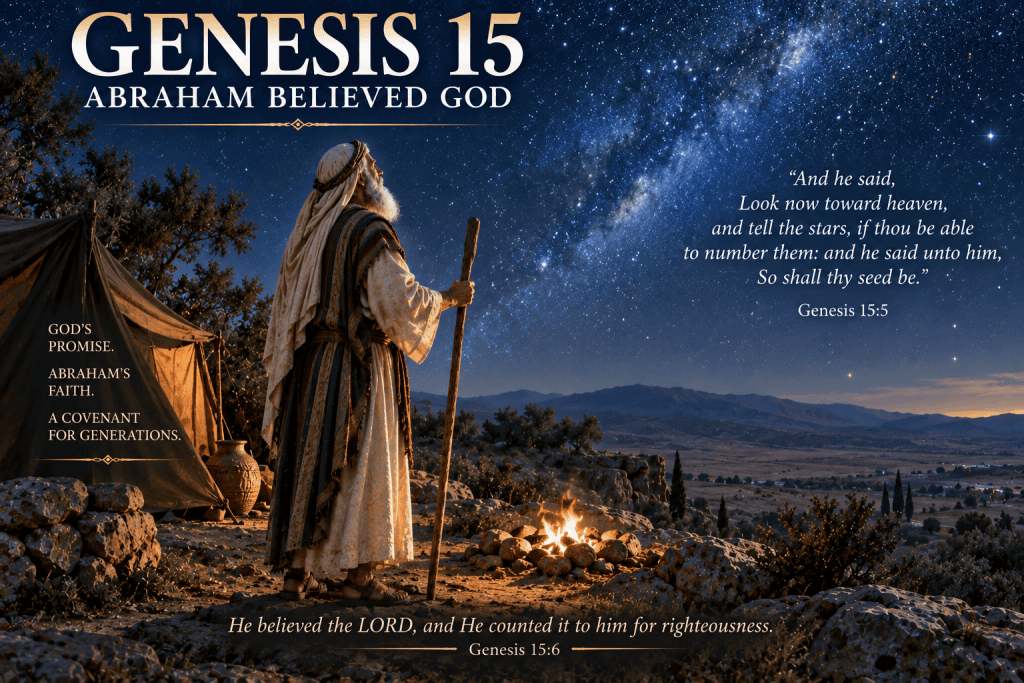
Then God took Abram outside.
“Look now toward heaven, and tell the stars, if thou be able to number them.” — Genesis 15:5
Imagine Abram standing beneath the ancient night sky.
No:
- city lights.
- streetlights.
- electric glow.
Only countless stars.
Then God said:
“So shall thy seed be.”
Abram had been looking at his age.
God told him to look at the stars.
Abram had been looking at what seemed impossible.
God told him to look at what God could do.
Sometimes faith requires us to lift our eyes.
Our circumstances may say:
Impossible.
God’s promises say:
Trust Me.
Abram Believed God
Then comes one of the most important statements in Scripture:
“And he believed in the LORD; and he counted it to him for righteousness.” — Genesis 15:6
Abram believed God.
That is the heart of the passage.
He did not perform a religious ritual or earn God’s favor through good works.
Instead, he trusted what God said.
And God:
“Counted it to him for righteousness.”
This verse becomes foundational in the New Testament doctrine of justification by faith.
Counted Righteous
Paul quotes Genesis 15:6 in Romans 4.
He asks:
“For what saith the scripture? Abraham believed God, and it was counted unto him for righteousness.” — Romans 4:3
Then Paul explains that righteousness is not earned by works.
Instead, God justifies the one who believes.
Therefore, Abraham becomes one of the great biblical examples of salvation by faith.
Abraham was not saved because he was perfect.
He was not.
Abraham was not saved because he never failed.
He did.
Abraham was counted righteous because he believed God.
Faith Is Not Merely Positive Thinking
Biblical faith is not vague optimism.
Abram did not simply think positively.
He believed the LORD.
Faith requires an object.
The power of faith is not found in how strongly we believe.
It is found in the One we believe.
Weak faith in a faithful God is better than strong confidence in something false.
Therefore, the important question is not simply:
“Do you have faith?”
The better question is:
“Whom are you trusting?”
God Repeated the Promise of the Land
The Lord then reminded Abram:
“I am the LORD that brought thee out of Ur of the Chaldees, to give thee this land to inherit it.” — Genesis 15:7
God pointed Abram back to His previous faithfulness.
That is often how God strengthens faith.
He reminds us:
I brought you this far.
Therefore, trust Me with what comes next.
When fear grows, it helps to remember what God has already done.
Remember:
- answered prayers.
- previous provision.
- times when God carried you through difficulty.
Past faithfulness encourages present trust.
Abram Asked for Assurance
Abram then asked:
“Lord GOD, whereby shall I know that I shall inherit it?” — Genesis 15:8
Again, Abram asked for assurance.
God responded by establishing a covenant ceremony.
This ceremony may seem strange to modern readers.
However, in the ancient world, covenants could be confirmed through solemn symbolic acts.
Animals were divided.
The parties to the covenant would pass between the pieces.
The ceremony communicated the seriousness of the agreement.
In effect, it said:
May what happened to these animals happen to me if I break this covenant.
Abram Prepared the Sacrifice
God told Abram to bring several animals.
Abram divided some of them and arranged the pieces.
Then he waited.
Birds of prey came down upon the carcasses.
Abram drove them away.
The scene suggests patience.
Again, Abram was waiting.
He waited for a promised son.
Now he waited for God to act in the covenant ceremony.
Faith often involves waiting.
However, waiting does not mean doing nothing.
Abram prepared what God commanded and remained there.
A Deep Sleep Fell Upon Abram
As the sun went down:
“A deep sleep fell upon Abram; and, lo, an horror of great darkness fell upon him.” — Genesis 15:12
Then God revealed something difficult.
Abram’s descendants would become strangers in another land.
They would be afflicted for four hundred years.
Afterward, however, God would bring them out with great substance.
This prophecy pointed forward to Israel’s time in Egypt and the Exodus.
God’s promise would be fulfilled.
But the path would include suffering.
That teaches us another important truth.
God’s promises do not mean God’s people will never experience hardship.
Sometimes suffering becomes part of the road toward fulfillment.
God Knows the Future
God told Abram what would happen generations later.
Egypt had not yet enslaved Israel.
Moses had not yet been born.
The Exodus was centuries away.
Nevertheless, God already knew.
That should strengthen our confidence.
The future is unknown to us.
It is not unknown to God.
We cannot see tomorrow.
God already stands beyond it.
Therefore, we do not need to know everything the future holds when we know the One who holds the future.
The Amorites and God’s Patience
Genesis 15:16 includes an important statement:
“For the iniquity of the Amorites is not yet full.”
God promised that Abram’s descendants would later possess the land.
However, judgment upon the people already living there would not come immediately.
Why?
Because their iniquity was not yet full.
This shows us God’s patience.
God did not judge arbitrarily.
He allowed time.
Judgment came only after continued wickedness.
Therefore, this passage reminds us that God’s justice is never impulsive.
He is patient.
Yet His patience does not mean sin will never be judged.
The Smoking Furnace and Burning Lamp
After sunset, Abram saw:
“A smoking furnace, and a burning lamp that passed between those pieces.” — Genesis 15:17
These symbols represented God’s presence.
Most importantly, notice who passed between the pieces.
God did.
Abram did not.
That detail is crucial.
The fulfillment of the covenant rested upon God.
God was binding Himself to His promise.
Abram’s future did not rest upon Abram’s ability to be perfect.
It rested upon the faithfulness of God.
God Made a Covenant
Genesis 15:18 says:
“In the same day the LORD made a covenant with Abram.”
Then God defined the land He would give to Abram’s descendants.
The promise became formalized in covenant.
God had spoken and committed Himself.
Therefore, Abram could trust the promise even before he saw its fulfillment.
Biblical faith rests upon the Word of a covenant-keeping God.
Faith and Waiting
Genesis 15 speaks especially to people who are waiting.
Perhaps:
- God has answered some prayers but not others.
- you are waiting for direction.
- you are waiting for reconciliation.
- you are waiting for a situation to change.
- you have prayed for years.
Abram understood waiting.
Years passed between promise and fulfillment.
However, God had not forgotten him.
Delay is not denial.
Silence is not absence.
Waiting does not mean God has stopped working.
What Genesis 15 Means for Us
1. God Is Greater Than Our Fear
Abram was afraid.
Therefore, God reminded him:
“I am thy shield.”
Fear becomes smaller when our view of God becomes larger.
2. God Himself Is Our Greatest Reward
Abram had refused Sodom’s riches.
God told him:
“I am thy exceeding great reward.”
What God gives is good.
However, knowing God is better.
3. Honest Questions Do Not Cancel Faith
Abram asked questions.
Nevertheless, he still trusted God.
Faith can wrestle without walking away.
4. God’s Plan Is Better Than Our Substitute
Abram thought Eliezer might be the answer.
God said no.
Therefore, we should be cautious about forcing our own solutions where God has asked us to trust Him.
5. Faith Believes God’s Word
Genesis 15:6 is the central verse.
Abram believed God.
As a result, God counted him righteous.
6. Righteousness Is Received by Faith
Paul uses Abraham to explain justification.
We do not earn salvation by works.
Rather, we receive righteousness by trusting God.
7. God Knows the Future
Abram did not know what would happen to his descendants.
God did.
Therefore, our uncertainty should not become distrust.
8. God Keeps Covenant
The smoking furnace and burning lamp passed between the pieces.
God committed Himself to His promise.
Ultimately, our hope rests in His faithfulness.
Abraham and the Gospel
Genesis 15 becomes enormously important in the New Testament.
Paul uses Abraham’s faith to explain the Gospel.
Romans 4 teaches that Abraham was counted righteous before circumcision and before the Law of Moses.
Therefore, salvation has always been rooted in grace received through faith.
Abraham believed God’s promise.
Christians believe God’s promise concerning His Son.
Jesus died for our sins.
He was buried.
Jesus rose again.
And everyone who trusts Him receives eternal life.
The principle is the same:
Believe God.
The Covenant-Keeping God
Abram did not yet have the son.
He did not yet possess the land.
His descendants had not yet become a nation.
Nevertheless, he had something certain.
He had God’s Word.
And ultimately, that was enough.
Faith does not demand that God fulfill everything on our schedule.
Faith says:
God has spoken. Therefore, I will trust Him.
The night sky still looked the same.
Abram’s body was still old.
Sarai was still barren.
The circumstances had not changed.
However, Abram had changed.
He believed.
And God counted it to him for righteousness.
That is the great message of Genesis 15.
Not:
Abram achieved something great.
But:
Abram believed a great God.
And that remains the heart of faith today.
WIM Takeaway
Genesis 15 teaches us that faith believes God even before His promise is visible. Abram trusted the LORD, and God counted that faith as righteousness. Moreover, God confirmed His covenant in a way that showed the promise rested upon His own faithfulness. Therefore, our hope is not in our ability to control the future but in the God who keeps His Word.
Questions for Reflection
- Why do you think Abram was afraid at the beginning of Genesis 15?
- What does it mean that God was Abram’s shield?
- Why is God Himself greater than any reward He can give us?
- What do Abram’s questions teach us about faith?
- Why was Eliezer not the answer to God’s promise?
- What does Genesis 15:6 teach us about justification by faith?
- How does Romans 4 use Abraham as an example of salvation?
- What does the covenant ceremony reveal about God’s faithfulness?
- How can remembering God’s past faithfulness help us trust Him now?
- Is there an area of your life where God is asking you to believe before you can see the answer?
<<Back to the Book of Genesis
Dr. Alan Holden has served in pastoral ministry for more than 35 years, preaching and teaching the Bible in churches across the United States. He holds a Doctor of Ministry from Luther Rice Seminary and a Master of Divinity from The Southern Baptist Theological Seminary. Through What’s It Mean?, he seeks to help readers understand the meaning of Scripture and grow in their walk with Christ. He is currently the pastor of Lake Saunders Baptist Church in Tavares, FL.