






Daniel 8: What Does the Vision of the Ram and the Goat Mean?
Introduction
Daniel 8 contains another prophetic vision given to Daniel. Unlike the previous chapter, which described broad world empires, this vision focuses more specifically on events involving the Jewish people and the land of Israel.
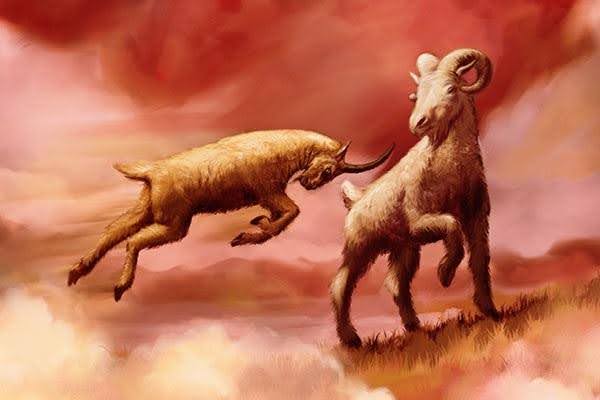
Daniel sees two powerful animals—a ram and a goat—engaged in a violent struggle. The vision reveals the rise of two major empires and predicts a future ruler who would persecute God’s people.
Daniel 8 teaches a powerful truth:
God reveals the future to show that He controls history and will ultimately judge evil.
The Vision at Shushan (Daniel 8:1–2)
Daniel received this vision during the reign of Belshazzar.
In the vision Daniel found himself in Shushan (Susa), which later became the capital of the Persian Empire.
This location hints that the prophecy will involve events connected to the Persian kingdom.
The Ram with Two Horns (Daniel 8:3–4)
Daniel first saw a ram standing beside a river.
The ram had two horns, but one horn grew higher than the other.
The ram charged:
- west
- north
- south
No animal could stand against it.
Later in the chapter the angel identifies the ram as the Medo-Persian Empire.
The two horns represent the two nations within the empire:
- Media
- Persia
The larger horn reflects the historical reality that Persia eventually became the dominant power.
The Goat from the West (Daniel 8:5–8)
Suddenly Daniel saw a male goat coming from the west.
The goat moved so quickly that it seemed to fly across the earth without touching the ground.
Between its eyes was one large horn.
The goat attacked the ram with tremendous fury and defeated it.
The ram’s power was completely broken.
The angel later explains that this goat represents the kingdom of Alexander the Great and the Greek Empire.
Alexander conquered the Persian Empire with incredible speed.
But at the height of his power, the large horn was broken.
Alexander died suddenly at the age of 32.
After his death the Greek Empire was divided into four kingdoms, symbolized by the four horns that replaced the original one.
The Rise of the “Little Horn” (Daniel 8:9–14)
From one of the four horns came a little horn that grew in power.
This ruler expanded toward:
- the south
- the east
- the “glorious land” (Israel)
This leader persecuted God’s people and attacked the temple worship.
The prophecy describes how he:
- opposed God
- stopped the daily sacrifices
- desecrated the sanctuary
Many historians believe this prophecy was fulfilled in the actions of Antiochus IV Epiphanes, a Greek ruler who brutally persecuted the Jews in the second century BC.
He desecrated the temple in Jerusalem and attempted to force Jewish people to abandon their faith.
However, many scholars also see this figure as a foreshadowing of a future end-times ruler who will oppose God and persecute believers.
The Angel Explains the Vision (Daniel 8:15–26)
Daniel struggled to understand the meaning of the vision.
Then the angel Gabriel appeared and explained it.
Gabriel confirmed the identities of the kingdoms:
- The ram = Medo-Persian Empire
- The goat = Greek Empire
Gabriel also explained that the persecuting ruler would eventually be destroyed.
“He shall be broken without hand.”
In other words, God Himself would bring about his downfall.
Daniel’s Reaction (Daniel 8:27)
After receiving the vision, Daniel was overwhelmed.
The Bible says he became physically ill and astonished by what he had seen.
The prophecy revealed terrible suffering that would come upon God’s people.
Yet it also assured Daniel that God remained in control.
Spiritual Lessons from Daniel 8
1. God knows the future in detail.
This prophecy accurately describes events that occurred centuries later.
2. Evil rulers may appear powerful.
But their authority is temporary and limited by God.
3. God’s people may experience persecution.
Faithfulness sometimes brings suffering.
4. God ultimately defeats evil.
Even the most powerful persecutors eventually fall under God’s judgment.
What Daniel 8 Reveals About God
Daniel 8 shows that God is:
- the ruler of history
- the revealer of future events
- the protector of His people
- the judge of wicked rulers
Even when evil appears to triumph, God’s plan continues to unfold.
Reflection Questions
- Why does God reveal future events in prophecy?
- What does this chapter teach about the limits of human power?
- How can believers remain faithful during times of persecution?
Conclusion
Daniel 8 reminds us that history unfolds according to God’s plan.
Empires rise and fall, powerful rulers appear and disappear, but God remains sovereign over every event.
The vision of the ram and the goat shows that even the most powerful kingdoms are temporary.
Ultimately, God will judge evil and establish His righteousness forever.
<<Back to Bible Passages
Book of Daniel Page–>CLICK HERE
Dr. Alan Holden has served in pastoral ministry for more than 35 years, preaching and teaching the Bible in churches across the United States. He holds a Doctor of Ministry from Luther Rice Seminary and a Master of Divinity from The Southern Baptist Theological Seminary. Through What’s It Mean?, he seeks to help readers understand the meaning of Scripture and grow in their walk with Christ. He is currently the pastor of Lake Saunders Baptist Church in Tavares, FL.
For more insights to the Book of Daniel, order Pastor Alan’s book from the links below.
Related Bible Studies