






Daniel 5: What Does the Handwriting on the Wall Mean?
Introduction
Daniel 5 records one of the most dramatic moments in the Old Testament. During a lavish banquet, a mysterious hand appeared and wrote a message on the palace wall. The message announced the fall of Babylon.
The king was terrified, but none of his wise men could interpret the writing.
Finally, the aged prophet Daniel was summoned to explain the message to the king.
Daniel 5 teaches a powerful truth:
God holds rulers accountable, and pride eventually leads to judgment.
Belshazzar’s Reckless Feast (Daniel 5:1–4)
The king of Babylon at this time was Belshazzar, a descendant of the royal family of Nebuchadnezzar II.
Belshazzar held a massive banquet for a thousand nobles.
During the feast he made a shocking decision.
He ordered the sacred vessels taken from the Temple in Jerusalem to be brought to the banquet.
These vessels had been captured decades earlier when Babylon conquered Judah.
The king and his guests used these holy items to drink wine while praising their pagan gods.
This act was not merely careless—it was open disrespect toward the God of Israel.
The Mysterious Hand Appears (Daniel 5:5–9)
Suddenly a supernatural event interrupted the feast.
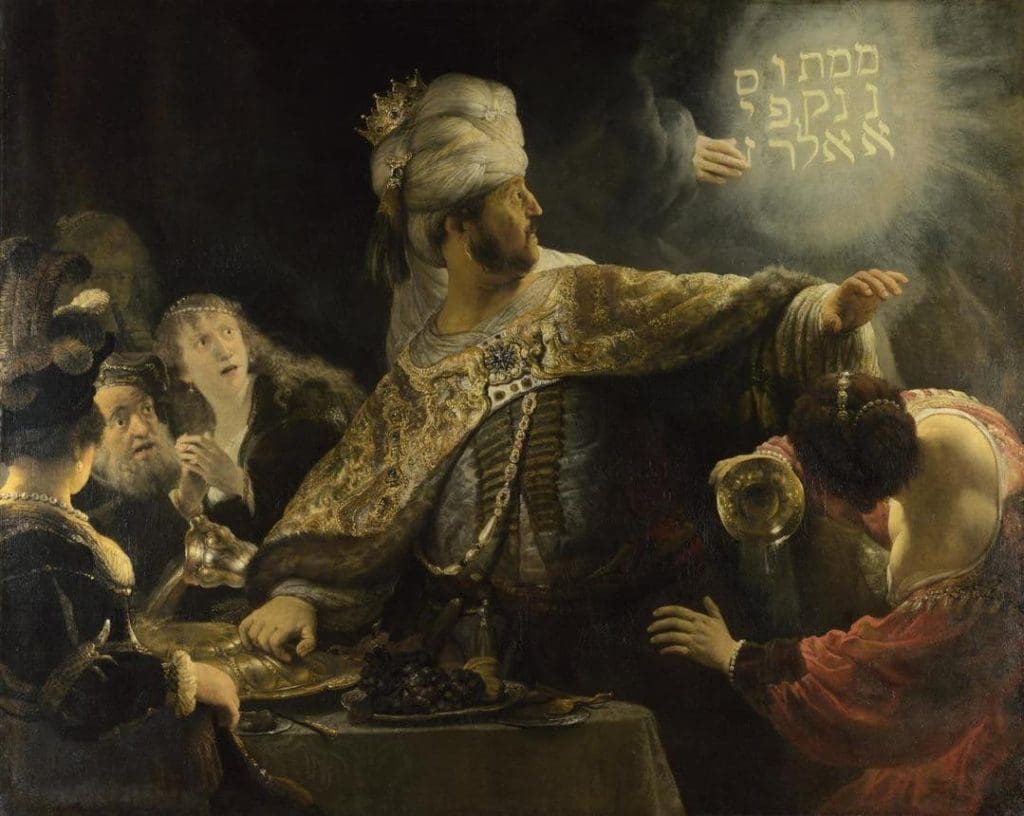
A hand appeared and began writing on the plaster wall of the palace.
The king watched as the message was written.
The Bible describes his reaction vividly:
- his face turned pale
- his thoughts terrified him
- his knees knocked together
Belshazzar immediately called for the astrologers and wise men to interpret the message.
He promised great rewards:
- royal clothing
- a gold chain
- the third highest position in the kingdom
But none of the wise men could read or explain the writing.
Daniel Is Summoned (Daniel 5:10–16)
The queen remembered the prophet Daniel, who had interpreted dreams during the reign of Nebuchadnezzar.
Daniel was known for:
- wisdom
- understanding
- the spirit of God
Belshazzar called for Daniel and repeated his offer of rewards if he could interpret the message.
Daniel agreed to explain the writing, but he refused the king’s gifts.
He came to deliver God’s message, not to seek personal gain.
Daniel Confronts the King (Daniel 5:17–24)
Before interpreting the writing, Daniel rebuked the king.
He reminded Belshazzar of the lesson God had taught Nebuchadnezzar.
God had humbled that powerful king because of pride.
Belshazzar knew this history.
Yet he refused to humble himself.
Instead, he dishonored God by using the sacred temple vessels for a drunken celebration.
Daniel declared:
“The God in whose hand thy breath is… hast thou not glorified.”
Belshazzar had ignored God’s authority, and now judgment had arrived.
The Meaning of the Writing (Daniel 5:25–28)
The mysterious message contained four words:
MENE, MENE, TEKEL, UPHARSIN
Daniel explained the meaning.
MENE
God has numbered the days of your kingdom and brought it to an end.
TEKEL
You have been weighed on the scales and found wanting.
PERES (UPHARSIN)
Your kingdom is divided and given to the Medes and Persians.
The message was clear.
Babylon’s rule was finished.
The Fall of Babylon (Daniel 5:29–31)
Despite the terrible prophecy, Belshazzar still honored his promise to Daniel.
Daniel was clothed in royal garments and given a gold chain.
But the king’s reign ended that very night.
The Medo-Persian forces entered Babylon and took control of the city.
Belshazzar was killed, and the empire passed to Darius the Mede.
The great Babylonian empire had fallen.
Spiritual Lessons from Daniel 5
1. Pride leads to judgment.
Belshazzar repeated the same mistake as Nebuchadnezzar but refused to learn from history.
2. God holds leaders accountable.
Kings and rulers answer to God for their actions.
3. Life and power are temporary.
Belshazzar’s kingdom ended in a single night.
Earthly power can disappear suddenly.
4. God sees what others ignore.
While the feast appeared successful, God had already weighed the king’s life and found it lacking.
What Daniel 5 Reveals About God
This chapter shows that God is:
- the judge of nations
- the ruler of history
- the one who weighs human hearts
- the one who determines the rise and fall of kingdoms
No ruler can escape God’s authority.
Reflection Questions
- What mistakes did Belshazzar repeat from Nebuchadnezzar’s life?
- What does the phrase “weighed and found wanting” teach about God’s judgment?
- How should believers live knowing that God evaluates every life?
Conclusion
Daniel 5 reminds us that power, wealth, and celebration cannot protect people from God’s judgment.
Belshazzar’s feast appeared successful and secure, yet his kingdom collapsed that very night.
The message written on the wall declared that his life and kingdom had been weighed and found lacking.
This chapter challenges every reader to consider an important question:
How will our lives measure when God weighs them?
<<Back to Bible Passages
Book of Daniel Page–>CLICK HERE
Dr. Alan Holden has served in pastoral ministry for more than 35 years, preaching and teaching the Bible in churches across the United States. He holds a Doctor of Ministry from Luther Rice Seminary and a Master of Divinity from The Southern Baptist Theological Seminary. Through What’s It Mean?, he seeks to help readers understand the meaning of Scripture and grow in their walk with Christ. He is currently the pastor of Lake Saunders Baptist Church in Tavares, FL.
For more insights to the Book of Daniel, order Pastor Alan’s book from the links below.
Related Bible Studies