







Daniel 11: Who Is the Powerful King Described in Daniel 11?
Introduction
Daniel 11 contains one of the most detailed prophecies in the entire Bible. The chapter describes a long series of conflicts between powerful kingdoms that would arise after the Persian Empire.
These events were revealed to Daniel long before they occurred in history.
Many of the events described in this chapter were later fulfilled through the struggles between the Greek kingdoms that emerged after the death of Alexander the Great.
Daniel 11 teaches an important truth:
God knows the future in remarkable detail and directs the course of history.
The Future of the Persian Empire (Daniel 11:1–2)
The angel explains that several kings would arise in Persia.
Eventually a very wealthy king would stir up conflict against Greece.
This prophecy is widely associated with the reign of Xerxes I, whose massive military campaign against Greece occurred in the fifth century BC.
The conflict between Persia and Greece would shape the political world of the ancient Near East.
The Rise of Greece (Daniel 11:3–4)
The prophecy then speaks of a mighty king who would arise and rule with great authority.
This description clearly points to Alexander the Great.
Alexander built one of the largest empires in the ancient world in an incredibly short time.
However, the prophecy also predicted that his kingdom would be broken and divided.
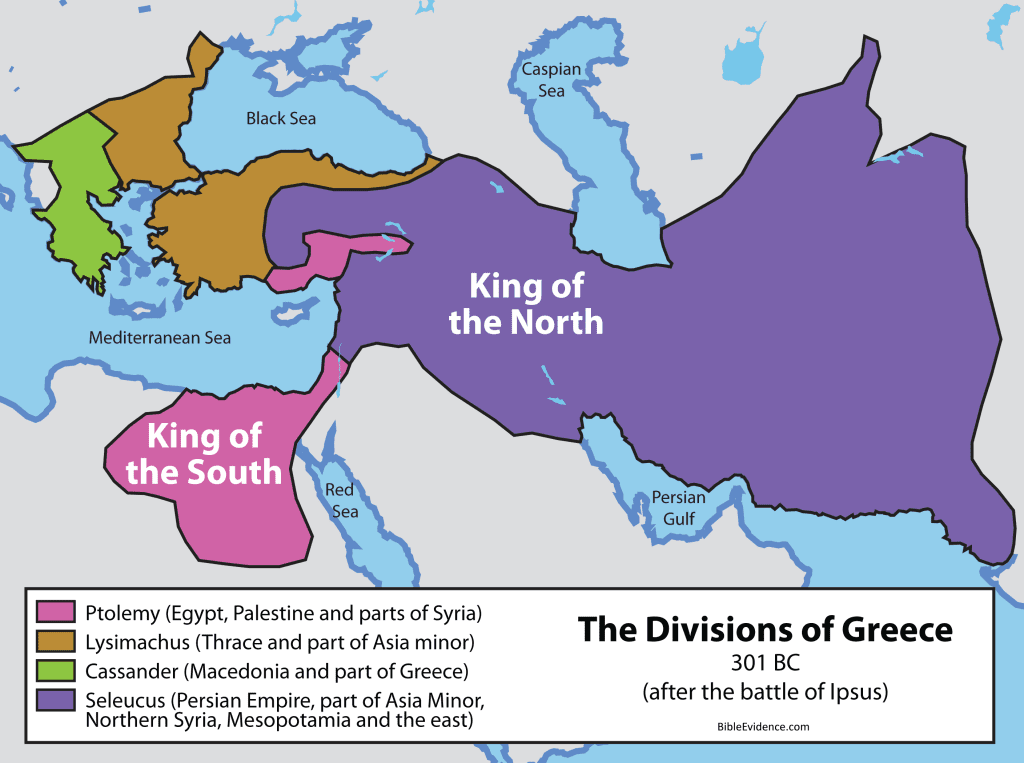
After Alexander’s death in 323 BC, his empire was divided among four generals.
The Kings of the North and South (Daniel 11:5–20)
The prophecy then focuses on a long struggle between two of these successor kingdoms:
- The King of the South — the Ptolemaic dynasty in Egypt
- The King of the North — the Seleucid dynasty in Syria
These kingdoms fought numerous wars for control of the region that included Israel.
Israel became a strategic territory caught between these competing powers.
The prophecy describes:
- political alliances
- military campaigns
- betrayals and intrigue
These conflicts dominated the Middle East for nearly two centuries.
The Persecution of God’s People (Daniel 11:21–35)
The prophecy eventually introduces a ruthless ruler.
Many scholars identify this figure with Antiochus IV Epiphanes, one of the most notorious kings of the Seleucid Empire.
Antiochus violently persecuted the Jewish people.
He desecrated the temple in Jerusalem and attempted to eliminate Jewish worship.
This event is often referred to as the “abomination of desolation.”
Despite severe persecution, many faithful Jews remained loyal to God.
Their resistance eventually led to the Maccabean revolt.
A Future Arrogant Ruler (Daniel 11:36–45)
The final section of the chapter describes a powerful and arrogant ruler who exalts himself above every god.
Some scholars believe this portion still refers to Antiochus Epiphanes, while others believe it points beyond him to a future end-times ruler.
This ruler:
- exalts himself above God
- uses military power aggressively
- faces opposition from surrounding nations
The prophecy ends with this ruler meeting his downfall.
Spiritual Lessons from Daniel 11
1. God knows history before it happens.
The level of detail in this prophecy demonstrates God’s complete knowledge of the future.
2. Political power is temporary.
Empires and rulers rise and fall, but none remain forever.
3. God’s people may face persecution.
Throughout history, faithful believers have often suffered opposition.
4. God ultimately judges evil rulers.
No tyrant escapes God’s authority.
What Daniel 11 Reveals About God
Daniel 11 shows that God is:
- sovereign over world events
- aware of every political change
- the protector of His people
- the final judge of every ruler
History unfolds exactly according to God’s plan.
Reflection Questions
- Why does God reveal detailed prophecy about future events?
- What does Daniel 11 teach about the temporary nature of political power?
- How should believers respond when facing opposition or persecution?
Conclusion
Daniel 11 is a remarkable prophecy that demonstrates God’s complete knowledge of history.
From the rise of Persia to the conflicts of the Greek kingdoms, the events described in this chapter unfolded exactly as God revealed centuries earlier.
The message is clear: God rules over history.
Even when nations clash and rulers seek power, the ultimate authority belongs to God alone.
<<Back to Bible Passages
Book of Daniel Page–>CLICK HERE
Dr. Alan Holden has served in pastoral ministry for more than 35 years, preaching and teaching the Bible in churches across the United States. He holds a Doctor of Ministry from Luther Rice Seminary and a Master of Divinity from The Southern Baptist Theological Seminary. Through What’s It Mean?, he seeks to help readers understand the meaning of Scripture and grow in their walk with Christ. He is currently the pastor of Lake Saunders Baptist Church in Tavares, FL.
For more insights to the Book of Daniel, order Pastor Alan’s book from the links below.
Related Bible Studies