







In Revelation 3:7–13, we read Jesus’ message to the Church of Philadelphia.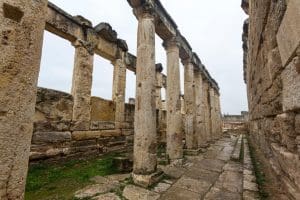
The Character of the City
Philadelphia was a city with a purpose—and that purpose helps us understand the kind of church Jesus commends.
“Philadelphia” means brotherly love. This was a city named for loyalty, devotion, and affection. It was meant to represent unity and commitment.
But more than that, Philadelphia was an emissary city. It stood on the edge of the Greek world, intentionally planted to spread Greek language and culture into surrounding regions as a mission outpost.
It was also strategically located on a major highway connecting continents. Because of this, it became a prosperous and influential city—people were always passing through.
Yet it was unstable. Frequent earthquakes shook the city. Buildings fell. Life was uncertain. Because of its beauty and architecture, it was called “little Athens,” but beneath that beauty was constant vulnerability.
This is the setting Jesus chose to describe the faithful church of Philadelphia:
- Positioned for influence
- Built for mission
- Living with instability
The Christ of the Church
Jesus introduces Himself with deliberate authority:
- “He who is holy and true”
He is absolutely pure and completely genuine—real God and real Man. He is not one voice among many. He is truth itself. - “He who has the key of David” (Isaiah 22:20–23)
This speaks of royal authority. Jesus alone opens and closes the kingdom.
What He opens, no one can shut.
What He shuts, no one can open.
Christ is declaring:
I decide who enters. I control access. I rule the mission.
The Comprehension of Christ
Jesus says, “I know your works.” That statement carries both comfort and weight.
1. He Knows Our Limitations
They had “little strength.”
This was not a powerful, influential church by human standards.
Yet weakness is not a barrier—it is often the very platform God uses.
2 Corinthians 12:9 — “My strength is made perfect in weakness.”
2. He Knows Our Faithfulness
- They kept His Word
- They did not deny His Name
They were not impressive—but they were faithful.
3. He Sets Before Them an Open Door
Jesus says, “See, I have set before you an open door.”
This is the language of mission and evangelism:
- 1 Corinthians 16:9 — a great and effective door
- 2 Corinthians 2:12 — a door opened by the Lord
- Colossians 4:3 — a door for the Word
The tragedy is this:
Sometimes we don’t see open doors because we are focused on closed ones.
They saw obstacles. Jesus saw opportunity.
What did this church have?
- Opportunity for evangelism
- Dependence on God
- Faithfulness to Christ
That is all God needs.
The Commendation of Christ
Jesus gives three powerful promises:
1. Vindication
Those who opposed and excluded them would one day recognize the truth.
2. Affirmation
“They will know that I have loved you.”
The world may misunderstand the church—but Christ does not.
3. Preservation
“I will keep you from the hour of trial.”
This points beyond ordinary persecution to a coming global testing—the Great Tribulation. Christ promises divine keeping for His faithful people.
The Challenge from Christ
“Behold, I am coming quickly.”
His return will be sudden and unexpected.
So what is the command?
“Hold fast what you have.”
Do not drift.
>Do not compromise.
>Do not abandon your witness.
Faithfulness is not flashy—but it is everything.
The Call of Christ to Overcomers
Jesus gives breathtaking promises to those who overcome:
1. A Pillar in God’s Temple
In a city shaken by earthquakes, everything collapsed—except the pillars.
Jesus says:
You will not fall.
You will stand forever.
2. A Permanent Dwelling
“He shall go out no more.”
In a city where people constantly fled after tremors, this promise meant everything: no more instability or fleeing from fear.
3. A New Identity
Jesus will write upon us:
- The Name of God → Ownership
- The Name of the City (New Jerusalem) → Citizenship
- His New Name → Union with Christ
This is the language of belonging, security, and eternal honor.
What’s It Mean?
The Missionary Church is not defined by size, strength, or influence.
It is defined by:
- Faithfulness to the Word
- Loyalty to the Name of Christ
- Sensitivity to open doors
- Dependence on God in weakness
God is not looking for strong churches.
He is looking for faithful ones.
You may feel like you have “little strength.”
Good. That is exactly the kind of church Jesus uses.
The question is not:
How much power do we have?
The question is:
Are we walking through the doors Christ has opened?
Final Challenge
There is an open door in front of you.
- A conversation
- A relationship
- A moment to speak truth
Don’t miss it because you’re looking at your weakness.
Christ opened the door.
Step through it.
Enjoy simple, Bible-centered teaching? Receive a short Daily Devotion by email and spend a few minutes each day in God’s Word. For more information, CLICK HERE.
Continue studying Revelation: Explore our complete chapter-by-chapter guide to the Book of Revelation, including the seven churches, seals, trumpets, Antichrist, Millennium, final judgment, and New Jerusalem–OR go:
<<Back to Church of Sardis OR Forward to Church of Laodicea>>
<<Back to Bible Passages
For more insights to the Book of Revelation, order Pastor Alan’s book from the links below.
Dr. Alan Holden has served in pastoral ministry for more than 35 years, preaching and teaching the Bible in churches across the United States. He holds a Doctor of Ministry from Luther Rice Seminary and a Master of Divinity from The Southern Baptist Theological Seminary. Through What’s It Mean?, he seeks to help readers understand the meaning of Scripture and grow in their walk with Christ. He is currently the pastor of Lake Saunders Baptist Church in Tavares, FL.