






The Apostate Church: What’s It Mean? (Revelation 3:14–22)
A Simple, Biblical Explanation of Apostasy
Apostasy is not open rebellion—it is subtle departure.
It is not always loud rejection—it is often quiet indifference. This is evident in the church of Laodicea, where indifference became their downfall.
The church at Laodicea represents a people who profess Christ outwardly but function without Him inwardly.
Apostasy is not just leaving Christ—it is living as though you no longer need Him.
What Is the Apostate Church in the Bible?
Revelation 3:14–22 presents the final church in Christ’s messages—a church that had everything except spiritual reality.
The Character of the City
Laodicea helps us understand the church.
- “Laodicea” = “rule of the people”
→ A picture of human authority replacing God’s authority - A wealthy, self-sufficient city
- Famous for black wool textiles
- Known for eye-salve medicine
- Rebuilt itself after an earthquake (AD 60) without outside help
- A deeply religious culture
- Required citizens to confess: “Caesar is Lord”
- Hosted temples to false gods like Asclepius (healing)
- A compromised environment
- Lukewarm, mineral-heavy water from distant springs
- Leaders known for negotiation and compromise
👉 This city produced a church that mirrored its culture:
- Self-reliant
- Prosperous
- Religious
- Compromising
The Christ of the Church
Before Christ rebukes, He reveals who He is:
- The Amen
→ The final word. The certainty of God’s promises (2 Corinthians 1:20) - The Faithful and True Witness
→ Unlike a compromising church, Jesus speaks truth without distortion - The Beginning (Source) of Creation
→ Not created—the Creator Himself
→ Caesar is not Lord—Christ is Lord
👉 The issue in Laodicea was not information—it was authority.
The Comprehension of Christ
Christ sees what others cannot.
1. Lukewarm Faith
“You are neither cold nor hot… you are lukewarm.” (Revelation 3:15–16)
- Hot water heals
- Cold water refreshes
- Lukewarm water sickens
This is not about emotional intensity—it is about spiritual usefulness.
Illustration:
- The thief on the cross → cold, but aware of his need
- John → hot, walking closely with Christ
- Judas → lukewarm, near Jesus but never surrendered
👉 Lukewarm Christianity is the most dangerous condition—
close enough to feel safe, far enough to be lost.
2. Spiritual Self-Deception
“You say, ‘I am rich… and have need of nothing.’” (v.17)
But Christ says:
- You are wretched
- Miserable
- Poor
- Blind
- Naked
They trusted:
- Wealth → as proof of blessing
- Health → as proof of favor
- Religion → as proof of righteousness
👉 But they lacked:
- True spiritual riches (faith tested by fire)
- True sight (illumination of the Holy Spirit)
- True covering (Christ’s righteousness)
3. A Man-Centered Church
Laodicea was a church of majority rule, not Scripture rule.
When the people rule instead of the Word, Christ is pushed outside.
The Caution of Christ
Christ does not ignore this condition—He confronts it.
1. Tough Love
“As many as I love, I rebuke and chasten.” (v.19)
- Rebuke → exposes sin
- Chastening → corrects the believer
👉 No discipline = no relationship (Hebrews 12:8)
2. A Clear Command
- “Be zealous” → Get serious again
- “Repent” → Turn back to Christ
👉 Indifference is not a personality trait—it is a spiritual problem.
The Call of Christ
1. A Shocking Picture
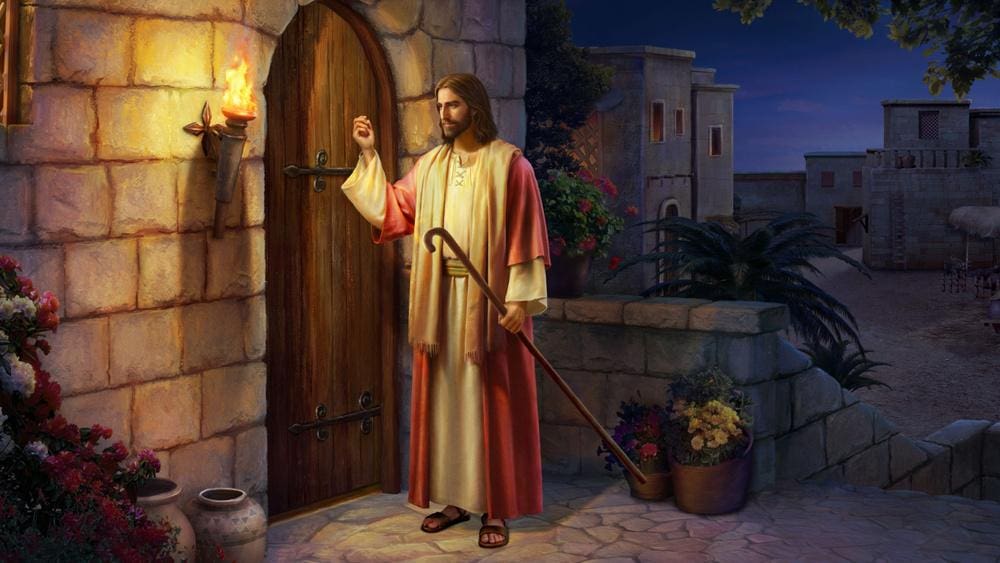
“Behold, I stand at the door and knock.” (v.20)
This is not outside the world—
This is Jesus outside His own church.
- Philadelphia → open door to ministry
- Laodicea → closed door to Christ
👉 Religion continued—but Christ was excluded.
2. A Personal Invitation
“If anyone hears My voice…”
Even in a compromised church, individual response matters.
- Christ will enter
- Christ will fellowship
- Christ will restore
3. A Powerful Promise
“To him who overcomes…”
- You can overcome:
- Indifference
- Compromise
- Self-reliance
- The reward:
- A place with Christ on His throne
👉 The end of repentance is not shame—it is reign with Christ.
The Apostate Church and the Gospel
Laodicea teaches a sobering truth:
You can have:
- Doctrine
- Structure
- Wealth
- Activity
…and still not have Christ at the center.
The Gospel calls us back to:
- Dependence, not self-sufficiency
- Faith, not appearance
- Righteousness in Christ, not reputation
- Fellowship with Christ, not mere religion
Conclusion
The Apostate Church is not just a warning to others—it is a mirror.
- Where have we become lukewarm?
- Where have we trusted ourselves instead of Christ?
- Where have we excluded Jesus while keeping religion?
“He who has an ear, let him hear what the Spirit says to the churches.”
Enjoy simple, Bible-centered teaching? Receive a short Daily Devotion by email and spend a few minutes each day in God’s Word. For more information, CLICK HERE.
Continue studying Revelation: Explore our complete chapter-by-chapter guide to the Book of Revelation, including the seven churches, seals, trumpets, Antichrist, Millennium, final judgment, and New Jerusalem–OR go:
<<Back to Church of Philadelphia OR Forward to Chapter 4>>
<<Back to Bible Passages
For more insights to the Book of Revelation, order Pastor Alan’s book from the links below.
Dr. Alan Holden has served in pastoral ministry for more than 35 years, preaching and teaching the Bible in churches across the United States. He holds a Doctor of Ministry from Luther Rice Seminary and a Master of Divinity from The Southern Baptist Theological Seminary. Through What’s It Mean?, he seeks to help readers understand the meaning of Scripture and grow in their walk with Christ. He is currently the pastor of Lake Saunders Baptist Church in Tavares, FL.