

What Is the Biblical Definition of Eternal Life?

biblical-definition-of-eternal-life

A Simple, Biblical Definition of Eternal Life

Eternal life is often misunderstood as simply living forever. While eternal life does involve unending existence, the Bible describes it as far more than length of life. The biblical definition of eternal life reveals it is not merely about duration—it is about relationship, quality, and certainty.

To understand the Christian hope rightly, we must understand what eternal life truly means according to Scripture.

What Is Eternal Life in the Bible?

In the Bible, eternal life is life with God that begins now and continues forever. Eternal life is not something believers receive only after death. It begins the moment a person trusts Christ by faith.

Jesus defines eternal life clearly:

“This is eternal life, that they know You, the only true God, and Jesus Christ whom You have sent.”

Therefore, eternal life is knowing God—not merely knowing about Him, but being reconciled to Him through Christ.

Eternal Life Is a Gift, Not a Reward

Scripture teaches that eternal life is a gift of grace, not a reward for good behavior. No one earns eternal life by moral effort, religious devotion, or obedience.

Jesus gives eternal life to those who trust in Him. He secures it by His life, death, and resurrection. Because eternal life depends on Christ, it is certain and secure.

If eternal life could be earned, it could also be lost. But Scripture presents eternal life as God’s gracious gift to believers.

Eternal Life Begins Now

One of the most overlooked truths about eternal life is that it begins in the present. Believers already possess eternal life, even as they await its fullness.

This means the Christian life is not merely preparation for heaven—it is participation in eternal life now. Believers experience forgiveness, reconciliation, peace with God, and spiritual renewal in the present age.

This changes how believers live, suffer, and hope.

Eternal Life and Resurrection

While eternal life begins now, it will one day be fully realized through the resurrection. Scripture teaches that eternal life includes the resurrection of the body, not merely the survival of the soul.

The Christian hope is not escape from the physical world, but renewal of it. Eternal life involves restored bodies, renewed creation, and unbroken fellowship with God.

Eternal life is life as God intended it to be.

Eternal Life and Assurance

Because eternal life is God’s gift, believers can have assurance. Eternal life does not depend on human strength or consistency, but on God’s faithfulness.

Christ secures the promise of eternal life, even though believers may struggle, doubt, and grow slowly. Assurance does not come from perfection, but from trusting a perfect Savior.

Eternal Life Shapes the Present

Eternal life gives perspective to the Christian life. It frees believers from despair, fear of death, and hopelessness.

Because eternal life is certain:

  • Suffering is not meaningless
  • Death is not final
  • Obedience is not wasted

Eternal life gives courage to live faithfully in the present world.

Eternal Life and Holiness

Also, eternal life also shapes how believers pursue holiness. Those who have eternal life desire to live in a way that reflects their future with God.

Therefore, holiness is not an attempt to earn eternal life—it is a response to having received it. Believers live differently because they belong to God forever.

Conclusion: Eternal Life Made Simple

Eternal life is not just living forever.
You cannot earn eternal life.
>
Eternal life is not uncertain.

Eternal life is knowing God through Jesus Christ—now and forever.

Eternal life begins at salvation.
Jesus Himself secures eternal life.
Eternal life will be fully revealed in the resurrection.

That is eternal life.

<<Back to the Teaching Library


If this article helped you, you may enjoy the Free 7-Day Eternal Life Devotional.

Download the Free 7-Day Devotional


Dr. Alan Holden has served in pastoral ministry for more than 35 years, preaching and teaching the Bible in churches across the United States. He holds a Doctor of Ministry from Luther Rice Seminary and a Master of Divinity from The Southern Baptist Theological Seminary. Through What’s It Mean?, he seeks to help readers understand the meaning of Scripture and grow in their walk with Christ. He is currently the pastor of Lake Saunders Baptist Church in Tavares, FL.


Heaven and Hell: What’s It Mean?

A Simple, Biblical Explanation of Heaven and Hell

Few topics stir stronger emotions than heaven and hell. Some speak of heaven vaguely, as a peaceful place after death. Others avoid the subject of hell altogether, finding it uncomfortable or outdated. Scripture, however, speaks plainly about both—and it does so for our good.

The Bible presents heaven and hell not as myths or metaphors, but as real and eternal destinations with eternal significance.

What Is Heaven in the Bible?biblical-definition-of-eternal-life

In Scripture, heaven is the eternal dwelling place of God’s redeemed people. Heaven is not a dreamlike existence or a loss of personal identity. It is life fully restored in the presence of God.

Heaven is described as:

  • Life with God
  • Freedom from sin and suffering
  • Joy, peace, and worship
  • The fulfillment of God’s promises

Heaven is not about floating on clouds or endless boredom. It is the fullness of eternal life—life as God intended it to be.

Heaven Is Ultimately Life with God

The greatest joy of heaven is not the absence of pain, but the presence of God. Heaven is the place where God dwells with His people without sin or separation.

Believers will see God, know Him fully, and worship Him joyfully. Heaven is not centered on human desires, but on God’s glory—and that is what makes it perfect.

What Is Hell in the Bible?heaven and hell 2

The Bible also speaks clearly about hell. Hell is the place of final judgment and separation from God for those who reject Him.

Scripture presents hell as:

  • Conscious punishment
  • Just judgment for sin
  • Separation from God’s gracious presence
  • Eternal in consequence

Hell is not a scare tactic or a metaphor for earthly suffering. It is a sobering reality that reveals the seriousness of sin and the holiness of God.

Why Hell Exists

Hell exists because God is just. If God did not judge sin, He would not be good. Evil would go unanswered, and justice would be meaningless.

Hell is not evidence of God’s cruelty, but of His righteousness. At the same time, Scripture makes clear that God takes no pleasure in judgment. He is patient, merciful, and calls sinners to repentance.

The existence of hell magnifies the urgency and beauty of the gospel.

Heaven, Hell, and the Gospel

Heaven and hell cannot be understood apart from the gospel. The gospel explains how sinners can escape judgment and receive eternal life.

Jesus spoke about heaven and hell more than anyone else in Scripture. He warned of judgment and invited sinners to salvation. At the cross, Jesus bore judgment so that believers might inherit heaven.

The difference between heaven and hell is not human goodness, but Christ’s saving work.

Heaven, Hell, and Eternal Life

Eternal life includes both a future hope and a present reality. Those who belong to Christ already possess eternal life and await its fullness in heaven. Those who reject Christ remain under judgment.

Scripture presents only two final destinations—not many paths or outcomes. Heaven and hell reveal the eternal weight of decisions made in this life.

Heaven and Hell Shape the Christian Life

Understanding heaven gives believers hope. Understanding hell gives believers urgency and compassion.

Heaven encourages perseverance in suffering.
Hell motivates evangelism and prayer.

Together, they remind us that life is meaningful, choices matter, and eternity is real.

Conclusion: Heaven & Hell Made Simple

Heaven is real.
Hell is real.
Both are eternal.

Heaven is life forever with God through Jesus Christ.
Hell is eternal separation from God because of sin.

The gospel stands between heaven and hell, calling sinners to repentance and faith.

That is what the Bible teaches about heaven and hell.

<<Back to the Teaching Library


If this article helped you, you may enjoy the Free 7-Day Eternal Life Devotional.

Download the Free 7-Day Devotional


Dr. Alan Holden has served in pastoral ministry for more than 35 years, preaching and teaching the Bible in churches across the United States. He holds a Doctor of Ministry from Luther Rice Seminary and a Master of Divinity from The Southern Baptist Theological Seminary. Through What’s It Mean?, he seeks to help readers understand the meaning of Scripture and grow in their walk with Christ. He is currently the pastor of Lake Saunders Baptist Church in Tavares, FL.

What Does Holiness Mean?

What Does Holiness Mean?

holiness
Holiness = set apart from darkness unto light (1 Peter 1:15–16).


Holiness is one of the most important themes in the Bible—and one of the most misunderstood. Some hear the word holiness and think of moral superiority or religious performance. Others assume holiness is outdated or incompatible with grace.

Scripture presents holiness not as pride or legalism, but as God’s purpose for His redeemed people.

What Is Holiness in the Bible?

In the Bible, holiness means being set apart for God, living a godly life. At its core, it is about belonging to God and reflecting His character.

God is holy by nature. He is morally pure, completely righteous, and entirely distinct from sin. When Scripture calls God’s people to be holy, it is calling them to live in a way that reflects who He is.

We do not create a godly life. It is the result of God’s work in the lives of those He saves.

Holiness Begins with God, Not Us

One of the Bible’s clearest teachings is that holiness begins with God’s initiative. God sets His people apart before they begin to live set-apart lives.

God declares believers holy in Christ before they grow in holiness in practice. This distinction is important. It is not something we achieve to belong to God; it is something we pursue because we already belong to Him.

Holiness flows from identity, not insecurity.

Holiness Is Not Legalism

Living a holy life is not keeping a long list of rules. Legalism focuses on external behavior without inward transformation. Biblical holiness, however, begins in the heart.

It is not about earning God’s favor. It is about responding to God’s grace. When holiness is separated from grace, it becomes harsh and lifeless. When grace is separated from holiness, it becomes empty and misleading.

True holiness shapes our love for God, not fear of rejection.

Obedience

Holiness expresses itself through obedience. While it describes being set apart, obedience describes how that set-apart life is lived.

Obedience is the pathway of sanctification—not the foundation of it. God’s commands guide believers into lives that reflect His goodness and wisdom.

Sanctification is not perfection, but progression. Believers grow in sanctification over time as they are shaped by God’s Word and Spirit.

Grace

God’s favor does not weaken the call to a godly life; it strengthens it. Grace frees believers from the power of sin so they can pursue righteousness.

Grace teaches believers to reject sin and live in a way that honors God. It is not a rejection of grace—it is the fruit of grace at work.

Where grace is truly understood, holiness follows.

Everyday Life

Holiness is not limited to religious activities. It shapes how believers think, speak, and live in everyday life.

Holiness affects:

  • Our desires and priorities
  • Our relationships
  • Our use of time and resources
  • Our response to temptation

It is lived out in ordinary faithfulness, not extraordinary displays.

Hope

Holiness is also forward-looking. Believers pursue sanctification now because they are preparing for eternal life with a holy God. One day, sanctification will be complete. Until then, believers grow by God’s grace.

It is not about becoming something new on our own—it is about becoming what God has already declared us to be in Christ.

Conclusion

A godly life is not self-righteousness.
It is not legalism.
It is not perfection.

Holiness is being set apart for God and shaped by His grace.

A godly life flows from salvation.
It grows through obedience.
It reflects the character of God.

That is biblical holiness.

<<Back to the Teaching Library


If this article helped you, you may enjoy the Free 7-Day Eternal Life Devotional.


Download the Free 7-Day Devotional


Dr. Alan Holden has served in pastoral ministry for more than 35 years, preaching and teaching the Bible in churches across the United States. He holds a Doctor of Ministry from Luther Rice Seminary and a Master of Divinity from The Southern Baptist Theological Seminary. Through What’s It Mean?, he seeks to help readers understand the meaning of Scripture and grow in their walk with Christ. He is currently the pastor of Lake Saunders Baptist Church in Tavares, FL.

What Does Obedience Really Mean?

What Does Obedience Really Mean?

obedience
Obedience Is Trust in Action


Obedience is often misunderstood in Christian teaching. Some view it as the way to earn God’s favor. Others react against that idea and treat it as optional or even harmful to grace. Both views miss what Scripture actually teaches.

Biblical obedience is neither legalism nor rebellion. It is the natural response of a heart changed by grace.

What Is Obedience in the Bible?

In the Bible, obedience means willing submission to God’s will and Word. It is not mere outward conformity, but inward agreement that leads to action.

Obedience flows from trust. When we trust God, we obey Him. When obedience is separated from faith, it becomes empty rule-keeping. When faith is separated from obedience, it becomes hollow profession.

True obedience begins in the heart and expresses itself in the life.

Scripture is clear that obedience does not earn salvation. No one is justified by obedience to the law. Salvation is by grace alone, through faith alone, because of Christ alone.

Obedience is the result of salvation, not the cause of it.

This distinction protects the gospel. If obedience becomes the basis of salvation, grace is destroyed. If it is removed entirely, faith becomes meaningless.

Obedience: Love and Grace

Jesus consistently connects obedience with love. It is not driven by fear of punishment, but by love for God.

When believers obey, they are not trying to impress God. They are responding to the love they have already received. Love changes the motivation for obedience from obligation to gratitude.

Obedience says, “Because You love me, I want to walk in Your ways.”

Grace does not cancel obedience—it produces it. Grace changes the heart so that obedience becomes possible and desirable.

Where grace is truly understood, obedience follows. Grace trains believers to say no to sin and yes to righteousness. Obedience is the evidence that grace is at work.

Grace does not lower God’s standards. Grace gives believers the desire and power to live according to them.

Obedience Is Imperfect but Directional

Biblical obedience does not mean perfection. Christians still struggle with sin and weakness. Obedience is about direction, not flawlessness.

A believer’s life is marked by a growing desire to please God, even when failures occur. When Christians stumble, they return to God in repentance—not abandonment.

Obedience grows over time as believers mature in faith.

Obedience: Freedom and the Christian Life

Contrary to popular belief, obedience is not bondage. Scripture teaches that obedience to God leads to freedom. God’s commands are not oppressive; they are life-giving.

True freedom is not doing whatever we want—it is living as God designed us to live. Obedience aligns us with God’s good purposes.

Obedience touches every area of the Christian life:

  • Our thoughts and desires
  • Our words and actions
  • Our relationships
  • Our priorities

Obedience is not selective. To follow Christ is to submit every part of life to His lordship.

Conclusion

Obedience is not legalism.
It is not optional.
It is not perfection.

Obedience is loving submission to God flowing from grace.

Obedience follows faith.
It reflects love.
It honors the Lordship of Christ.

That is biblical obedience.

<<Back to the Teaching Library


If this article helped you, you may enjoy the Free 7-Day Eternal Life Devotional.

Download the Free 7-Day Devotional


Dr. Alan Holden has served in pastoral ministry for more than 35 years, preaching and teaching the Bible in churches across the United States. He holds a Doctor of Ministry from Luther Rice Seminary and a Master of Divinity from The Southern Baptist Theological Seminary. Through What’s It Mean?, he seeks to help readers understand the meaning of Scripture and grow in their walk with Christ. He is currently the pastor of Lake Saunders Baptist Church in Tavares, FL.

What Does “Jesus Is Lord” Mean?

What Does “Jesus Is Lord” Mean?

Jesus is Lord
His Lordship is grounded in His resurrection (Romans 1:4).


The confession “Jesus is Lord” is one of the earliest and most important declarations in Christianity. It appears simple, yet it carries profound meaning. Many people use the word Lord casually, without realizing what they are affirming.

In Scripture, declaring that Jesus is Lord is not merely a statement of respect—it is a declaration of allegiance, authority, and worship.

What Does “Lord” Mean in the Bible?

In the Bible, Lord refers to one who possesses authority, ownership, and the right to rule. When applied to Jesus, the title means far more than “teacher” or “leader.”

The New Testament frequently uses the word Lord to identify Jesus with God Himself. To call Jesus Lord is to confess that He shares in God’s authority, glory, and rule.

This confession is not symbolic. It is theological and personal.

Jesus Is Lord Because He Is God

Scripture teaches that Jesus is not merely sent by God—He is God in the flesh. Jesus possesses divine authority, receives worship, forgives sins, and rules over creation.

Calling Him Lord means acknowledging His divine identity. It means recognizing that He has absolute authority over all things, including our lives.

Jesus is not one lord among many. He is Lord over all.

He Is Lord Because He Reigns

The lordship of Jesus is not limited to His earthly ministry. After His resurrection, Jesus was exalted and seated at the right hand of God. He reigns now with all authority in heaven and on earth.

Jesus is not waiting to become Lord—He already is.

This means history is not moving toward chaos, but toward the fulfillment of Christ’s rule. Every power, kingdom, and authority ultimately answers to Him.

Confessing Jesus as Lord

Scripture teaches that salvation involves confessing Jesus as Lord. This confession is not a magical phrase, but an expression of faith.

This means:

  • Submitting to His authority
  • Trusting His saving work
  • Acknowledging His right to rule

Faith receives Christ as Savior and Lord—not one without the other.

Lordship and Obedience

Because He is Lord, obedience matters. Obedience does not earn salvation, but it flows from acknowledging Christ’s authority.

Calling Him Lord while refusing His commands is a contradiction. True faith produces a desire to follow Christ, even when obedience is costly.

Lordship does not mean perfection. It means direction. A heart that bows to Christ seeks to walk in His ways.

Jesus Is Lord

Over Life and Death

The lordship of Jesus extends beyond this life. Jesus has authority over life, death, judgment, and eternity. Because He is Lord, believers face death not with fear, but with hope.

Jesus holds the keys of death and life. Nothing happens outside His sovereign rule.

And the Christian Life

Acknowledging Him as Lord shapes every aspect of the Christian life:

  • How we think
  • How we live
  • How we suffer
  • How we hope

The Christian life is not self-directed. It is Christ-directed. To belong to Jesus is to live under His gracious and rightful rule.

Conclusion

Jesus is not merely a helper.
>
Jesus is not merely a teacher.
>
Jesus is not merely an example.

Jesus is Lord.

He is Lord by nature.
>
He is Lord by victory.
>
He is Lord by right.

And every knee will bow, and every tongue will confess that Jesus Christ is Lord—to the glory of God.

That is what it means to say: Jesus is Lord.

<<Back to the Teaching Library


Dr. Alan Holden has served in pastoral ministry for more than 35 years, preaching and teaching the Bible in churches across the United States. He holds a Doctor of Ministry from Luther Rice Seminary and a Master of Divinity from The Southern Baptist Theological Seminary. Through What’s It Mean?, he seeks to help readers understand the meaning of Scripture and grow in their walk with Christ. He is currently the pastor of Lake Saunders Baptist Church in Tavares, FL.



If this article helped you, you may enjoy the Free 7-Day Eternal Life Devotional.

Download the Free 7-Day Devotional

What Does Justification Mean?

What Does Justification Mean?

A Simple, Biblical Definitionjustification

Justification is one of the most important words in the Bible—and one of the least understood. Many Christians use the word without being able to explain it. Others confuse it with forgiveness, transformation, or moral improvement.

Scripture gives it a clear and powerful meaning. When we understand it, the gospel becomes clearer, assurance becomes stronger, and grace becomes sweeter.

What Is Justification in the Bible?

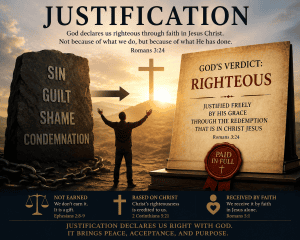
In the Bible, justification is God’s legal declaration that a sinner is righteous in His sight. It is a courtroom term. To justify does not mean to make someone righteous inwardly; it means to declare them righteous legally.

Justification answers a crucial question:
How can a sinful person be right with a holy God?

The answer is not in human effort, but in God’s gracious verdict.

Not Moral Improvement

One of the most common misunderstandings is that justification means becoming morally better. While the Christian life involves growth and change, that is not justification.

Justification does not describe what happens inside us; it describes what God declares about us.

At the moment of justification, the believer is still imperfect. But God declares the sinner righteous because of Christ, not because of personal goodness.

By Grace Alone

Scripture repeatedly teaches that justification is a gift of grace. It cannot be earned, assisted, or maintained by works.

God justifies the ungodly—not those who have cleaned themselves up. This means a divine declaration of righteousness depends entirely on God’s grace, not human obedience.

If justification were based on works, it would never bring peace or assurance. Grace alone explains how sinners can stand confidently before God.

Through Faith Alone

Justification is received through faith. Faith is not a work that earns vindication; it is the means by which we receive God’s verdict.

Faith looks away from self and rests in Christ alone. The believer is justified not because faith is strong, but because Christ is sufficient.

Faith does not add to Christ’s work. It receives it.

Justification and Christ’s Righteousness

The foundation of justification is the righteousness of Jesus Christ. Jesus lived a perfectly obedient life and died as a substitute for sinners–God credits Christ’s righteousness to the believer.

This is often called imputed righteousness. Our sin is counted to Christ at the cross, and His righteousness is counted to us by faith.

It is not God pretending sinners are righteous. It is God declaring sinners righteous because Christ truly is righteous on their behalf.

Peace with God

One of the greatest results of justification is peace with God. The believer is no longer under condemnation. The legal case is settled. The verdict has been rendered.

Because God’s declaration of righteousness is a completed act, it does not fluctuate with feelings or performance. The believer’s standing before God is secure.

This is why justification produces confidence, humility, and gratitude—not pride.

The Christian Life

Justification happens once and forever. It is not repeated, reversed, or improved over time.

Growth in holiness follows justification, but it never replaces it. Obedience flows from being justified; it does not lead to justification.

Understanding this protects the gospel from distortion and guards believers from both pride and despair.

Conclusion: Justification Made Simple

Justification is not self-improvement.
It is not earned.
It is not temporary.

Justification is God declaring sinners righteous through faith in Jesus Christ.

God’s declaration of righteousness is by grace.
It is through faith.
It is based on Christ alone.

That is biblical justification.

<<Back to the Teaching Library


Dr. Alan Holden has served in pastoral ministry for more than 35 years, preaching and teaching the Bible in churches across the United States. He holds a Doctor of Ministry from Luther Rice Seminary and a Master of Divinity from The Southern Baptist Theological Seminary. Through What’s It Mean?, he seeks to help readers understand the meaning of Scripture and grow in their walk with Christ. He is currently the pastor of Lake Saunders Baptist Church in Tavares, FL.


If this article helped you, you may enjoy the Free 7-Day Eternal Life Devotional.

Download the Free 7-Day Devotional

What Does Salvation Mean?

Read the article below or watch the video:

Salvation: the Divine Rescue from Sin
Learn the biblical definition of salvation, how it works, and why it is a gift of grace.

What Does Salvation Mean?

Salvation is the heart of the Christian message, yet many people struggle to explain what it actually means. Some think of it as becoming a better person. Others view it as escaping hell or earning a place in heaven. While salvation includes rescue from judgment, the Bible presents salvation as something far deeper and more comprehensive.

To understand Christianity rightly, we must understand it biblically.

What Is Salvation in the Bible?

In Scripture, salvation means deliverance by God from sin, judgment, and eternal death. This deliverance is not self-improvement; it is divine rescue. The Bible consistently describes humanity as helpless to save itself and dependent entirely on God’s saving work.

Salvation includes:

  • Forgiveness of sins
  • Reconciliation with God
  • Freedom from the power of sin
  • The promise of eternal life

Salvation answers humanity’s greatest problem: separation from God because of sin.

It Is God’s Work, Not Ours

One of the clearest teachings of Scripture is that salvation is initiated, accomplished, and applied by God. People do not save themselves through morality, religion, or effort.

The Bible teaches that sinners are spiritually dead and unable to rescue themselves. Salvation, therefore, must come from outside of us. God acts first. He seeks, saves, and restores the lost.

Salvation is not a reward for good behavior; it is a gift of grace.

Jesus Saves

Scripture is unmistakably clear that salvation comes through Jesus Christ alone. Jesus did not merely make salvation possible; He accomplished it.

Through His life, Jesus fulfilled God’s law perfectly. Through His death, He bore the punishment for sin. Through His resurrection, He defeated death itself. Salvation rests entirely on the finished work of Christ.

There is no alternative path, substitute, or supplement to Jesus. Salvation is found in Him and in Him alone.

Rescue Received by Faith

Salvation is received by faith, not by works. Faith does not earn salvation; it receives what God freely gives.

Faith is trusting in Christ alone for forgiveness and life. It is resting in what Jesus has done rather than what we can do. Salvation is secure because it depends on Christ’s work, not the believer’s performance.

Salvation Is More Than a Moment

While salvation begins at a definite moment, it extends into the future. Scripture speaks of salvation as past, present, and future.

  • We have been saved from the penalty of sin
  • We are being saved from the power of sin
  • We will be saved from the presence of sin

Salvation transforms the whole person and shapes the entire Christian life.

What Salvation Produces

True salvation produces change. While works do not save, deliverance always results in a transformed life.

Salvation produces:

Good works are not the root of salvation—they are its fruit.

Because salvation is God’s work, believers can have assurance. Assurance does not come from perfection, but from trusting a faithful Savior.

Salvation rests on God’s promise, not human strength. The same God who saves also keeps His people.

Conclusion: Salvation Made Simple

Salvation is not self-help.
It is not earned.
It is not uncertain.

Redemption is God’s gracious rescue of sinners through faith in Jesus Christ.

God forgives.
>
God restores.
>
God transforms.

That is biblical salvation.

<<Back to the Teaching Library


Dr. Alan Holden has served in pastoral ministry for more than 35 years, preaching and teaching the Bible in churches across the United States. He holds a Doctor of Ministry from Luther Rice Seminary and a Master of Divinity from The Southern Baptist Theological Seminary. Through What’s It Mean?, he seeks to help readers understand the meaning of Scripture and grow in their walk with Christ. He is currently the pastor of Lake Saunders Baptist Church in Tavares, FL.


If this article helped you, you may enjoy the Free 7-Day Eternal Life Devotional.

Download the Free 7-Day Devotional

What Does Repentance Mean?

Repentance: What’s It Mean? A Simple Biblical Definition of Repentance

Read the article below or watch the video:

What Does Repentance Mean?

A Simple, Biblical Definition of Repentance

A biblical definition of repentance is needed now more than ever, because repentance is one of the most misunderstood words in the Bible. Many people associate repentance with guilt, shame, or punishment. Others reduce it to feeling sorry for wrongdoing. Some avoid the word altogether, assuming it contradicts grace. Clarifying the biblical definition of repentance helps clear up many of these misunderstandings.

Scripture presents repentance not as a burden, but as a gift—one that leads to forgiveness, freedom, and life.

What Is Repentance in the Bible?

In the Bible, repentance means a change of mind that results in a change of direction. The word does not merely describe regret over past actions; it describes a turning of the heart and will toward God. Here we see repentance goes beyond a feeling; the biblical definition of repentance requires a transformation of purpose and behavior.

Repentance involves recognizing sin for what it is, agreeing with God about it, and turning away from it. It is not self-punishment or self-reform. It is a response to God’s truth and mercy.

Jesus began His public ministry with this call:

“Repent, for the kingdom of heaven is at hand.”

Repentance is not optional in the Christian life. It is how we respond rightly to the gospel, and a true understanding embraces the biblical definition of repentance in daily faith.

Repentance Is More Than Feeling Sorry

Many people confuse repentance with remorse. Feeling sorrow over sin is important, but sorrow alone is not repentance. A person can feel guilty and still continue in the same direction. Recognizing the biblical definition of repentance guards us from reducing repentance to just emotion.

True repentance leads to change. It turns the sinner away from sin and toward God. It affects how we think, how we desire, and how we live.

Repentance says, “I was wrong—and I am turning to God.”

Repentance and Faith

Repentance and faith always go together. Repentance turns us away from sin; faith turns us toward Christ. Scripture never separates the two. By understanding faith alongside the biblical definition of repentance, we see their inseparable role in Christian life.

Faith trusts in Jesus for salvation.
Repentance abandons what separates us from Him.

One cannot exist without the other. Turning to Christ necessarily involves turning away from sin.

Repentance and Grace

Repentance does not earn forgiveness. Forgiveness is a gift of grace. But repentance is the God-ordained response to grace.

Grace does not eliminate repentance—it makes repentance possible. God’s kindness leads sinners to repentance, not indifference. Far from being opposed to grace, repentance is evidence that grace is at work in the heart and reflects the biblical definition of repentance as an ongoing return to God.

Repentance is not something we do to deserve mercy; it is how we receive mercy.

What Repentance Produces

True repentance produces fruit. While repentance does not make us perfect, it does make us different.

Repentance produces:

  • A growing hatred for sin
  • A renewed love for holiness
  • A desire to obey God
  • Humility rather than self-justification

Repentance is not a one-time event limited to conversion. It is a lifelong posture of the Christian heart, again pointing to the biblical definition of repentance as ongoing transformation.

Repentance in the Christian Life

The Christian life begins with repentance and continues with repentance. Believers do not repent to be saved again; they repent because they belong to God, which aligns with a biblical definition of repentance as a continual act of returning to Him.

When Christians sin, repentance restores fellowship—not salvation. Repentance keeps the heart tender, the conscience clear, and the believer dependent on grace.

Repentance is not a sign of spiritual failure. It is a sign of spiritual life.

Conclusion: Repentance Made Simple

Repentance is not regret.
>
Repentance is not self-punishment.
>
Repentance is not opposed to grace. In summary, holding to the biblical definition of repentance helps us distinguish it from regret or self-improvement.

It is turning from sin to God.

Repentance flows from grace.
>
Repentance walks hand in hand with faith.
>
Repentance leads to forgiveness, freedom, and life.

That is biblical repentance—this is what the biblical definition of repentance truly points us to in both doctrine and daily life.

<<Back to the Teaching Library


Dr. Alan Holden has served in pastoral ministry for more than 35 years, preaching and teaching the Bible in churches across the United States. He holds a Doctor of Ministry from Luther Rice Seminary and a Master of Divinity from The Southern Baptist Theological Seminary. Through What’s It Mean?, he seeks to help readers understand the meaning of Scripture and grow in their walk with Christ. He is currently the pastor of Lake Saunders Baptist Church in Tavares, FL.

If this article helped you, you may enjoy the Free 7-Day Eternal Life Devotional.

Download the Free 7-Day Devotional

What Is the Biblical Definition of Hope?

Biblical Definition of Hope
What does hope mean in the Bible?

What Is the Biblical Definition of Hope?

Don’t want to read the article below? You can watch a video:

A Simple, Biblical Definition of Hope

Hope is one of the most comforting words in the Christian faith—and one of the most misunderstood. In everyday language, hope often sounds uncertain: “I hope things work out” or “I hope this turns out well.” That kind of hope is closer to wishful thinking than confidence.

The biblical definition of hope is something entirely different. Scripture presents hope not as uncertainty, but as assurance grounded in God’s promises.

What Is the Biblical Definition of Hope?

In the Bible, hope is confident expectation based on God’s character and Word. Hope is not optimism about circumstances; it is trust in God’s faithfulness.

The apostle Paul describes hope this way:

“Hope does not put us to shame, because God’s love has been poured into our hearts” (Romans 5:5).

Biblical hope is never disconnected from truth. It is anchored in what God has promised and secured through Jesus Christ.

Hope Is Not Wishful Thinking

One of the most important distinctions Scripture makes is between biblical hope and human wishing.

Wishful thinking depends on outcomes we cannot control. Biblical hope depends on a God who cannot fail.

This is why Hebrews speaks of hope as something firm and secure. Hope rests on God’s unchanging nature, not on favorable circumstances. When Scripture speaks of hope, it speaks with certainty, not hesitation.

Hope and Faith: How They Work Together

Faith and hope are closely connected but not identical.

Faith trusts God’s Word in the present.
Hope looks forward with confidence to what God has promised for the future.

Hebrews 11 teaches that faith is the assurance of things hoped for. Hope gives direction to faith, while faith gives substance to hope. Together, they shape how believers live, suffer, and persevere.

The Object of Christian Hope

Biblical hope always has an object—and that object is not earthly success, comfort, or longevity. The ultimate object of Christian hope is God Himself and the future He has promised.

Scripture speaks often of the believer’s hope in:

  • The resurrection of the dead
  • Eternal life with Christ
  • The renewal of creation
  • The final victory over sin and death

Christian hope is not escapism. It is confidence that God will complete what He has begun.

How Hope Changes the Way We Live

Because biblical hope is certain, it changes how Christians face suffering, hardship, and even death.

Hope gives endurance.
>
Hope gives courage.
>
Hope gives perspective.

Believers can face trials without despair because suffering is not the final word. Death itself is not the end, but a doorway into the fulfillment of God’s promises. Hope anchors the soul when circumstances are unstable.

Hope and the Christian Life

Hope is not reserved for the future alone; it shapes daily obedience. When Christians live with hope, they resist despair, refuse bitterness, and endure faithfully.

It encourages holiness, because believers know their future is secure in Christ. Hope also fuels perseverance, because God’s promises extend beyond what we can see now.

Hope does not disappoint, because it rests on a faithful God.

Conclusion: The Simple Biblical Definition of Hope

Hope is not wishing.
>
Hope is not uncertainty.
>
Hope is not denial of suffering.

Hope is confident assurance grounded in God’s promises.

It looks forward with trust.
>
Hope endures with patience.
>
Hope anchors the soul in the faithfulness of God.

Undoubtedly,  that is biblical hope.

<<Back to the Teaching Library


Dr. Alan Holden has served in pastoral ministry for more than 35 years, preaching and teaching the Bible in churches across the United States. He holds a Doctor of Ministry from Luther Rice Seminary and a Master of Divinity from The Southern Baptist Theological Seminary. Through What’s It Mean?, he seeks to help readers understand the meaning of Scripture and grow in their walk with Christ. He is currently the pastor of Lake Saunders Baptist Church in Tavares, FL.

If this article helped you, you may enjoy the Free 7-Day Eternal Life Devotional.

Download the Free 7-Day Devotional

What Does the Gospel Mean?

Read the article below or watch the following video:

What Does the Gospel Mean?

A Simple, Biblical Definition of the Gospel

The word gospel is familiar to Christians, yet often misunderstood. Some reduce the gospel to good advice. Others treat it as a self-improvement message or a call to moral living. Still others assume the gospel is simply a synonym for Christianity.

The biblical definition of the gospel is something far more specific—and far more powerful.

Biblical Definition of the Gospel
What does the Gospel mean in the Bible?

What Does “Gospel” Mean?

The word gospel literally means good news. But it is not just any good news. The gospel is the good news of what God has done in Jesus Christ to save sinners.

The gospel is not a command telling us what to do.
>
The gospel is an announcement telling us what God has done.

The apostle Paul summarizes the gospel clearly:

“Christ died for our sins according to the Scriptures, He was buried, and He was raised on the third day” (1 Corinthians 15:3–4).

That message is the heart of Christianity.

The Gospel Is News, Not Advice

This distinction is crucial. Advice tells you how to improve your situation. News tells you what has already happened.

The gospel does not begin with you must change.
The gospel begins with God has acted.

Christianity is not about climbing up to God through effort or morality. It is about God coming down to us in grace. The gospel announces that salvation has been accomplished—not that it must be achieved.

Why the Biblical Definition of the Gospel Is Necessary

The gospel only makes sense when we understand humanity’s problem. Scripture teaches that all people are sinners, separated from God, and unable to save themselves. No amount of good works, religious devotion, or moral reform can remove guilt or reconcile us to God.

The gospel addresses this problem directly. Jesus lived the life we failed to live. He died the death we deserved to die. He rose again, defeating sin and death. Salvation is not earned—it is received.

The Gospel and Faith

The gospel must be believed. Faith is the means by which we receive the gospel’s benefits. It does not save because it is strong; faith saves because it trusts in a strong Savior.

Faith rests not in feelings or effort, but in the finished work of Christ. The object of saving faith is always Jesus.

The Gospel and Grace

The gospel is a message of grace from beginning to end. Salvation is offered freely, not as a reward for obedience, but as a gift to the undeserving.

Grace explains why salvation is possible.
Grace explains why salvation is secure.

The gospel leaves no room for boasting. Everything needed for salvation has been provided by God.

The Gospel and Hope

The gospel does not only address the past and present; it secures the future. Because Jesus rose from the dead, believers have a living hope. The gospel promises resurrection, eternal life, and the restoration of all things.

Christian hope is not grounded in personal success or earthly comfort. It is grounded in the risen Christ and the promises secured by His victory.

What the Gospel Produces

The gospel does not merely inform—it transforms.

The gospel produces repentance and faith.
>
The gospel produces obedience rooted in gratitude.
>
The gospel produces humility, assurance, and love.

Obedience flows from the gospel; it never replaces it. Good works are the fruit of salvation, not the cause of it.

Conclusion: The Gospel Made Simple

The gospel is not advice.
>
The gospel is not self-help.
>
The gospel is not moral reform.

The gospel is the good news that God saves sinners through Jesus Christ.

Christ has lived.
>
Christ has died.
>
Christ has risen.

And because of that, God forgives, restores, and gives sinners eternal life.

Finally, that is the gospel.

<<Back to the Teaching Library


Dr. Alan Holden has served in pastoral ministry for more than 35 years, preaching and teaching the Bible in churches across the United States. He holds a Doctor of Ministry from Luther Rice Seminary and a Master of Divinity from The Southern Baptist Theological Seminary. Through What’s It Mean?, he seeks to help readers understand the meaning of Scripture and grow in their walk with Christ. He is currently the pastor of Lake Saunders Baptist Church in Tavares, FL.

If this article helped you, you may enjoy the Free 7-Day Eternal Life Devotional.

Download the Free 7-Day Devotional