







The Lord’s Supper: What’s It Mean?
Key Scriptures: Matthew 26:26–29; Luke 22:14–20; 1 Corinthians 10:16–17; 1 Corinthians 11:23–29. These passages are central to understanding the meaning and significance of the Lord’s Supper.
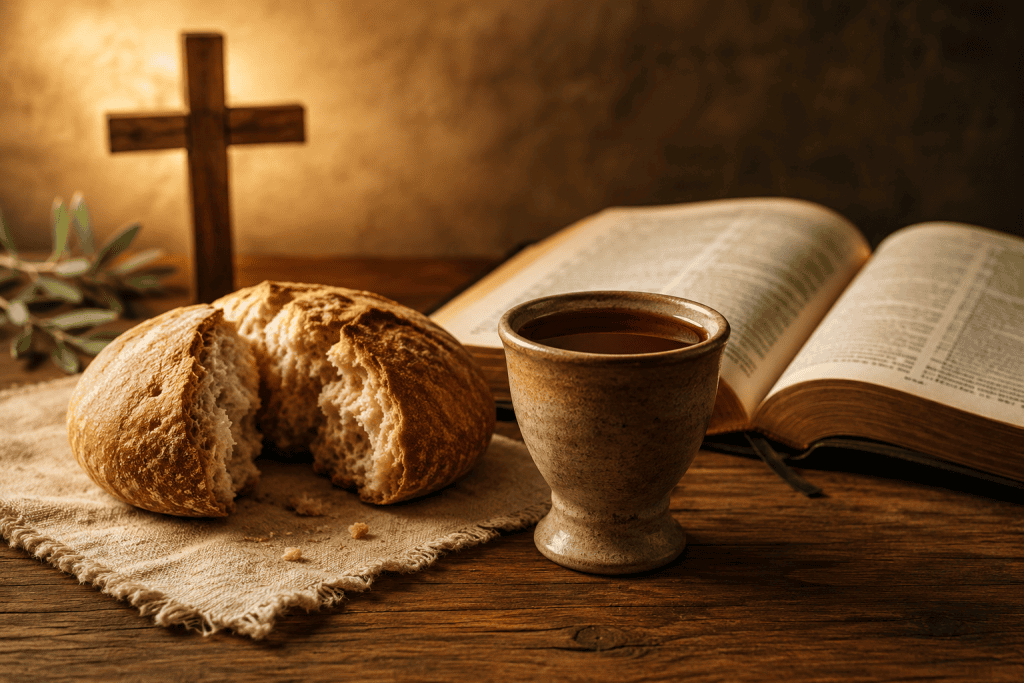
Few moments in Christian worship are as simple—and as meaningful—as the Lord’s Supper. A small piece of bread. A cup containing the fruit of the vine. Two ordinary elements placed before believers to remind us of an extraordinary Savior.
Jesus gave the Lord’s Supper to His disciples on the night before His crucifixion. He knew what awaited Him. Judas would betray Him. Peter would deny Him. The disciples would scatter. Before the next day ended, Jesus would hang on a Roman cross.
Yet during that final meal, Jesus took bread, gave thanks, broke it, and gave it to His disciples. Then He took the cup and gave it to them. Through these simple actions, Jesus gave His church a continuing reminder of His sacrifice and a proclamation of the Gospel.
The Lord’s Supper calls us to remember Christ’s sacrifice, examine our hearts, celebrate our fellowship, proclaim the Gospel, and anticipate Christ’s return.
First, What Is the Lord’s Supper?
The Lord’s Supper is an ordinance Jesus gave to His church as a visible reminder of His death for our sins.
Paul wrote:
“For I have received of the Lord that which also I delivered unto you” (1 Corinthians 11:23).
The Lord’s Supper did not originate with church tradition. Jesus Himself established it.
On the night of His betrayal, Jesus took bread and said:
“This is my body, which is broken for you: this do in remembrance of me” (1 Corinthians 11:24).
Then He took the cup and said:
“This cup is the new testament in my blood: this do ye, as oft as ye drink it, in remembrance of me” (1 Corinthians 11:25).
The bread represents Christ’s body given for us. The cup represents His blood shed for us.
The elements do not save us. They point us to the One who does.
The Lord’s Supper is not another sacrifice of Christ. Jesus completed His sacrifice on the cross. The Supper directs our attention back to that finished work.
Second, The Lord’s Supper Helps Us Remember
Jesus said:
“This do in remembrance of me.”
That simple command tells us the central purpose of the Lord’s Supper.
Remember Jesus.
We are prone to forget. We become distracted by work, bills, responsibilities, disappointments, illnesses, politics, entertainment, and the ordinary pressures of life. Even Christians can become so occupied with living that we lose sight of the One who gave us life.
The Lord’s Supper brings us back to the cross.
When we see the bread, we remember the body of Jesus given for us.
When we see the cup, we remember His blood shed for the forgiveness of sins.
We remember:
- Gethsemane,
- the crown of thorns,
- the nails,
- the cross,
- His words:
“It is finished” (John 19:30).
The Lord’s Supper does not ask us merely to remember that Jesus died. It asks us to remember why He died.
He died for us.
Peter explained:
“Who his own self bare our sins in his own body on the tree” (1 Peter 2:24).
Every observance of the Lord’s Supper quietly declares, Jesus died for sinners, and I am one of the sinners for whom He died.
Third, The Lord’s Supper Proclaims the Gospel
The Lord’s Supper looks backward to Calvary, but it also speaks to the present.
Paul wrote:
“For as often as ye eat this bread, and drink this cup, ye do shew the Lord’s death till he come” (1 Corinthians 11:26).
The word shew means to proclaim or announce.
Every time the church observes the Lord’s Supper, we preach a sermon without standing behind a pulpit.
The bread says, His body was given for us.
The cup says, His blood was shed for us.
Together they proclaim:
Christ died for our sins.
The Gospel is not primarily about what we can do for God. It is the good news of what God has done for us through Jesus Christ.
Paul summarized it plainly:
“Christ died for our sins according to the scriptures; And that he was buried, and that he rose again the third day” (1 Corinthians 15:3–4).
The Lord’s Supper keeps that Gospel at the center of the church.
Programs may change. Music styles may change. Buildings may change. Cultures may change.
But the message must never change:
Jesus Christ died for sinners and rose again.
Fourth, The Lord’s Supper Reminds Us of the New Covenant
When Jesus gave the cup to His disciples, He said:
“This cup is the new testament in my blood” (Luke 22:20).
The word testament can also be translated covenant.
Under the Old Covenant, animal sacrifices repeatedly reminded Israel of sin and the need for atonement. Those sacrifices pointed forward to something greater.
They pointed to Christ.
John the Baptist saw Jesus and declared:
“Behold the Lamb of God, which taketh away the sin of the world” (John 1:29).
Jesus became the final and sufficient sacrifice for sin.
The writer of Hebrews says:
“But this man, after he had offered one sacrifice for sins for ever, sat down on the right hand of God” (Hebrews 10:12).
Jesus does not need to be sacrificed again.
Jesus’ sacrifice was enough.
The Lord’s blood was enough.
Christ’s grace is enough.
The Lord’s Supper reminds believers that our relationship with God rests upon the finished work of Jesus Christ.
Fifth, The Lord’s Supper Calls Us to Examine Ourselves
The Lord’s Supper is a celebration, but it is also a serious moment of worship.
Paul instructed:
“But let a man examine himself, and so let him eat of that bread, and drink of that cup” (1 Corinthians 11:28).
Notice that Paul does not say, “Examine everyone else.”
He says, examine yourself.
Before receiving the Lord’s Supper, we should ask God to search our hearts.
Is there:
- sin I need to confess?
- bitterness I refuse to release?
- someone I need to forgive?
Have I allowed something to come between the Lord and me?
Am I living in obedience to Christ?
Self-examination does not mean that we must somehow make ourselves worthy of Christ. None of us could ever accomplish that.
We come because of grace.
But grace should never make us careless about sin. The Lord’s Supper gives us an opportunity to confess our sins and renew our commitment to walk faithfully with Christ.
John gives believers this promise:
“If we confess our sins, he is faithful and just to forgive us our sins, and to cleanse us from all unrighteousness” (1 John 1:9).
The Lord’s Table is therefore not merely a place of examination.
It is also a place of grace.
Sixth, The Lord’s Supper Reminds Us That We Are One Body
Communion is personal, but it is never merely private.
Paul wrote:
“For we being many are one bread, and one body: for we are all partakers of that one bread” (1 Corinthians 10:17).
Look around the church during the Lord’s Supper.
You will see different ages, backgrounds, personalities, occupations, experiences, and opinions.
But every believer comes to the same table.
There is no special bread for wealthy Christians; no different cup for educated Christians; no superior place for important Christians.
We all come the same way.
We are sinners saved by grace.
At the foot of the cross, human pride disappears.
The Lord’s Supper reminds us that Christ did not merely save individuals. He made us members of His body.
That means division, bitterness, jealousy, gossip, and unforgiveness have no proper place among God’s people.
The cross reconciles us to God and calls us to reconciliation with one another.
Seventh, The Lord’s Supper Looks Forward
The Lord’s Supper looks backward to the cross, but it also looks forward to the future.
Paul said we proclaim the Lord’s death:
“Till he come” (1 Corinthians 11:26).
Those three words are filled with hope.
He is coming again.
Jesus also told His disciples:
“I will not drink henceforth of this fruit of the vine, until that day when I drink it new with you in my Father’s kingdom” (Matthew 26:29).
Every observance of the Lord’s Supper therefore points in two directions.
We look backward and remember:
Jesus died.
Then we look forward and rejoice:
Jesus is coming again.
The cross is behind us.
The Kingdom is ahead of us.
Between the two, the church remembers, worships, witnesses, and waits.
Eighth, The Lord’s Table Is a Table of Grace
Perhaps one of the most beautiful truths about the Lord’s Supper is found in the people who first received it.
Think about those disciples sitting around the table with Jesus.
Within hours, they would fail Him.
Peter would deny Him.
The others would flee.
Jesus knew all of this.
Yet He gave them the bread.
He gave them the cup.
That is grace.
We do not come to the Lord’s Table because we have lived perfect lives and proclaiming our goodness.
We come:
- because Jesus gave His perfect life for imperfect people.
- proclaiming His goodness.
- celebrating our faithfulness.
- celebrating His faithfulness.
The Lord’s Supper tells the story of grace:
We were sinners.
>Christ loved us.
>Christ died for us.
>Christ saved us.
>Christ keeps us.
And Christ is coming for us.
Ninth, What Should I Do When I Receive the Lord’s Supper?
When your church observes the Lord’s Supper, do not allow the moment to become routine.
Remember. Think about what Jesus endured to save you.
Repent. Ask the Holy Spirit to reveal any sin that needs to be confessed.
Give thanks. Thank Jesus for His body given and His blood shed for you.
Forgive. Release bitterness toward others as you remember how completely Christ has forgiven you.
Rejoice. Your salvation rests upon Christ’s finished work, not your ability to earn God’s favor.
Look forward. Remember that the Savior who died, rose again, ascended into heaven, and promised to return.
What’s It Mean?
The Lord’s Supper is far more than bread and a cup.
It is:
- remembrance—Jesus died for us,
- proclamation—the Gospel is still our message,
- examination—we search our hearts before God,
- fellowship—we belong to one body in Christ,
- thanksgiving—our salvation is entirely the result of God’s grace, and
- hope—Jesus Christ is coming again.
The next time you hold the bread and the cup, remember that you are holding symbols of the greatest demonstration of love the world has ever known.
Jesus said:
“This do in remembrance of me.”
So remember the cross, the blood, the empty tomb, His grace, and His promise:
He is coming again.
<<Back to the Teaching Library
Dr. Alan Holden has served in pastoral ministry for more than 35 years, preaching and teaching the Bible in churches across the United States. He holds a Doctor of Ministry from Luther Rice Seminary and a Master of Divinity from The Southern Baptist Theological Seminary. Through What’s It Mean?, he seeks to help readers understand the meaning of Scripture and grow in their walk with Christ. He is currently the pastor of Lake Saunders Baptist Church in Tavares, FL.