







Sanctification: What’s It Mean?
Key Scriptures: John 17:17; Romans 6:11–14; Romans 12:1–2; 1 Corinthians 6:11; 1 Thessalonians 4:3; 5:23–24; Hebrews 10:14; 12:14; 1 Peter 1:15–16
Salvation does more than change where we will spend eternity. It changes who we are and begins changing how we live.
When God saves a sinner, He forgives that person’s sins, declares him righteous through faith in Jesus Christ, and gives him new life. But God does not stop there. He begins a lifelong work of transforming that believer into the likeness of Christ.
The Bible calls this work sanctification.
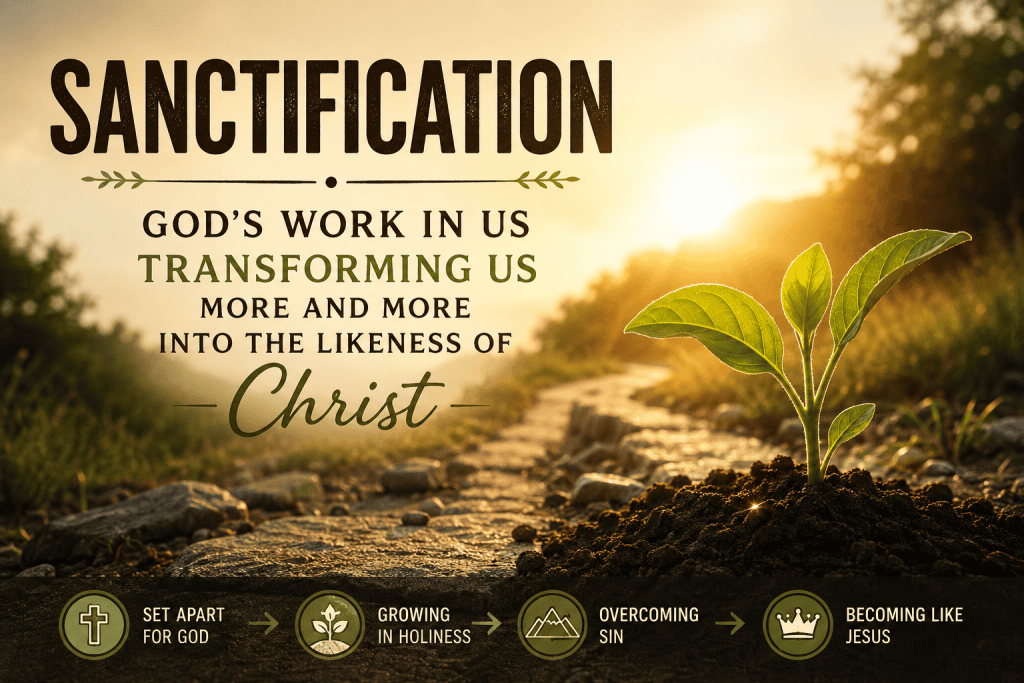
Sanctification means that God sets us apart for Himself and progressively makes our lives more consistent with our new identity in Christ. It is the continuing work of God’s grace by which believers grow in holiness, overcome sin, and become more like Jesus.
“For this is the will of God, even your sanctification.” — 1 Thessalonians 4:3
What Does Sanctification Mean?
The words sanctify, saint, and holy come from the same basic biblical idea: to be set apart for God.
Something holy belongs to God and is devoted to His purposes. Therefore, when God sanctifies us, He claims us as His own and begins shaping our lives according to His character.
Paul reminded the Corinthian believers:
“But ye are washed, but ye are sanctified, but ye are justified in the name of the Lord Jesus, and by the Spirit of our God.” — 1 Corinthians 6:11
Notice the change: you were living one way, but now you are something different.
The Christian life begins with a changed relationship with God, and that changed relationship produces a changed life.
Justification and Sanctification Are Different
We must understand the difference between justification and sanctification.
Justification is God’s declaration that the sinner who trusts Christ is righteous before Him. It happens because of Christ’s righteousness, not ours.
Sanctification is God’s continuing work of making the justified believer increasingly holy in everyday life.
We might put it this way:
Justification changes our standing before God. Sanctification changes our living before God.
Justification is complete. Sanctification continues throughout the Christian life.
We never become more justified than we were the moment we trusted Christ. But we should continually grow in holiness, obedience, wisdom, love, and Christlike character.
Hebrews 10:14 beautifully brings these truths together:
“For by one offering he hath perfected for ever them that are sanctified.”
Christ’s sacrifice completely secures our acceptance before God, while His grace continues its transforming work within us.
Three Aspects of Sanctification
The Bible describes sanctification in ways that help us see three aspects of God’s work.
1. We Have Been Set Apart
When we trust Christ, we belong to Him.
Paul addressed ordinary Christians as “saints” because they had been set apart for God. They were not called saints because they had achieved sinless perfection. They were saints because they belonged to Christ.
Our sanctification begins with our new identity.
We are no longer our own.
“For ye are bought with a price: therefore glorify God in your body, and in your spirit, which are God’s.” — 1 Corinthians 6:20
2. We Are Being Changed
This is the part of sanctification we experience every day.
God works in us through the Holy Spirit, His Word, prayer, worship, fellowship, trials, correction, and obedience.
Jesus prayed:
“Sanctify them through thy truth: thy word is truth.” — John 17:17
As we read Scripture, God exposes wrong thinking, confronts sinful attitudes, teaches us His ways, and renews our minds.
Paul writes:
“And be not conformed to this world: but be ye transformed by the renewing of your mind.” — Romans 12:2
Sanctification is transformation from the inside out.
3. We Will Be Made Perfect
Our sanctification will not be complete in this life.
Every Christian still struggles with sin. We grow, mature, and gain victories. But none of us reaches absolute sinless perfection before glory.
One day, however, God’s work will be complete.
When we see Christ, we will finally be free from the presence of sin.
“We know that, when he shall appear, we shall be like him; for we shall see him as he is.” — 1 John 3:2
What God began at salvation, He will finish in glory.
Who Does the Work?
Here we encounter an important question.
Does God sanctify us, or do we sanctify ourselves?
The biblical answer is that God works in us, and we respond through faithful obedience.
Paul explains:
“Work out your own salvation with fear and trembling. For it is God which worketh in you both to will and to do of his good pleasure.” — Philippians 2:12–13
Notice both sides.
We work out because God works in.
We cannot sanctify ourselves apart from God’s grace. Yet God’s grace does not encourage passivity. The Holy Spirit empowers us to obey, resist temptation, pursue holiness, forgive others, control our speech, serve faithfully, and put sinful habits to death.
Grace does not eliminate effort.
Grace makes godly effort possible.
Sanctification Is the Work of the Holy Spirit
We cannot become like Christ through determination alone.
Christianity is not simply a program of self-improvement. The Holy Spirit lives within every believer and produces spiritual fruit that human effort cannot manufacture.
“But the fruit of the Spirit is love, joy, peace, longsuffering, gentleness, goodness, faith, meekness, temperance.” — Galatians 5:22–23
A fruit tree does not strain to glue fruit onto its branches. Fruit grows because life is within the tree.
In the same way, Christlike character grows as the Holy Spirit works within the surrendered believer.
Our responsibility is to walk in fellowship with Him.
“Walk in the Spirit, and ye shall not fulfil the lust of the flesh.” — Galatians 5:16
Sanctification Requires Putting Sin to Death
Growing in holiness involves both putting off and putting on.
We put off sinful behavior and put on Christlike behavior.
Paul says:
“Likewise reckon ye also yourselves to be dead indeed unto sin, but alive unto God through Jesus Christ our Lord.” — Romans 6:11
The Christian cannot say, “That’s just the way I am.”
Perhaps we have always had a bad temper or we have always worried. Perhaps gossip, bitterness, pride, jealousy, lust, greed, or selfishness has followed us for years.
But Christ has given us a new identity.
Sin may still tempt us, but sin is no longer our master.
Romans 6:14 declares:
“For sin shall not have dominion over you.”
Sanctification means learning to live in the freedom Christ has already given us.
Sanctification Is Usually Gradual
Most spiritual growth happens slowly.
We sometimes expect dramatic transformation overnight. Occasionally God gives remarkable victories very quickly. More often, however, spiritual maturity develops through thousands of small acts of faith and obedience.
A tree does not grow visibly from one morning to the next. But compare the tree today with the tree ten years ago, and the growth becomes obvious.
The Christian life works much the same way.
You may not notice spiritual growth every day. But over time there should be evidence.
Perhaps:
- you forgive more quickly,
- you worry less,
- your prayers have deepened,
- Scripture means more to you,
- you respond more patiently to difficult people, and
- sins that once controlled you now grieve you.
Those changes are evidence of God’s sanctifying work.
Trials Can Be Tools of Sanctification
We would probably choose an easier method, but God often uses hardship to make us more like Christ.
James writes:
“The trying of your faith worketh patience.” — James 1:3
Trials reveal what is inside us.
Pressure exposes our fears, pride, impatience, selfishness, and lack of faith. But those same difficulties give God opportunities to strengthen our faith and develop perseverance.
The trial itself may not be good, but God can accomplish good through it.
The sculptor removes pieces of stone to reveal the image he intends. In much the same way, God sometimes uses painful circumstances to remove things from our lives that do not resemble Christ.
Sanctification Is Not Sinless Perfection
Christians still sin.
John warned believers:
“If we say that we have no sin, we deceive ourselves, and the truth is not in us.” — 1 John 1:8
The difference is not that Christians never sin.
The difference is that Christians cannot make peace with sin.
The Holy Spirit convicts us. We confess, repent, and return to fellowship with God. Then we continue walking with Christ.
Spiritual maturity does not mean reaching the point where we no longer need grace.
It means increasingly realizing how desperately we need it.
What Does a Sanctified Life Look Like?
Sanctification touches every area of life.
It changes:
- how we speak,
- how we treat our families,
- how we handle money,
- what we watch,
- how we conduct ourselves at work,
- how we respond when someone hurts us,
- our priorities,
- what we desire,
- how we use our time,
- how we think about our bodies, and
- how we treat people who cannot do anything for us.
Holiness is not merely what happens inside a church building.
It is Christ being seen in us on Monday morning.
Don’t Measure Yourself Against Other Christians
One danger in the Christian life is comparing ourselves with other believers.
We can always find someone who appears less mature and congratulate ourselves. We can also find someone who seems far more mature and become discouraged.
Neither comparison helps.
Our standard is Jesus Christ.
The question is not, “Am I better than someone else?”
The better question is, “Am I becoming more like Jesus?”
That is the goal of sanctification.
God Will Finish What He Started
Sanctification can sometimes feel painfully slow.
We may become discouraged because we continue struggling with weaknesses we thought we would have conquered years ago.
But remember this: God has not abandoned His work in you.
Paul wrote:
“Being confident of this very thing, that he which hath begun a good work in you will perform it until the day of Jesus Christ.” — Philippians 1:6
Your hope does not rest in your ability to make yourself holy.
Your hope rests in the faithfulness of the God who saved you.
Paul closes his first letter to the Thessalonians with this prayer:
“And the very God of peace sanctify you wholly.” — 1 Thessalonians 5:23
Then he adds this wonderful promise:
“Faithful is he that calleth you, who also will do it.” — 1 Thessalonians 5:24
God calls us, saves us, sets us apart, works within us, and makes us more like Christ.
And one day, God will complete the work.
What’s It Mean?
Sanctification means that God has set believers apart as His own and, through the Holy Spirit, progressively transforms them into the likeness of Jesus Christ.
We are saved by grace, and grow by grace.
We do not pursue holiness so God will accept us. Instead, we pursue holiness because, through Christ, God already has accepted us.
The Christian life is not about becoming good enough to belong to Jesus.
It is about learning to live like people who already belong to Him.
So don’t become discouraged when you see areas of your life that still need work. Bring them to God. Stay in His Word. Walk in the Spirit. Confess sin quickly. Obey what God shows you. Keep your eyes on Christ.
The Master is still working.
And He intends to finish what He started.
Reflection Questions
- What is the difference between justification and sanctification?
- What area of your life is God currently working to change?
- Are there sins you have excused by saying, “That’s just the way I am”?
- How does God’s Word contribute to our sanctification?
- How has God used a difficult experience to make you more like Christ?
- What evidence of spiritual growth can you see in your life over the past several years?
- What practical step of obedience is God asking you to take today?
<<Back to the Teaching Library
Dr. Alan Holden has served in pastoral ministry for more than 35 years, preaching and teaching the Bible in churches across the United States. He holds a Doctor of Ministry from Luther Rice Seminary and a Master of Divinity from The Southern Baptist Theological Seminary. Through What’s It Mean?, he seeks to help readers understand the meaning of Scripture and grow in their walk with Christ. He is currently the pastor of Lake Saunders Baptist Church in Tavares, FL.