







Introduction
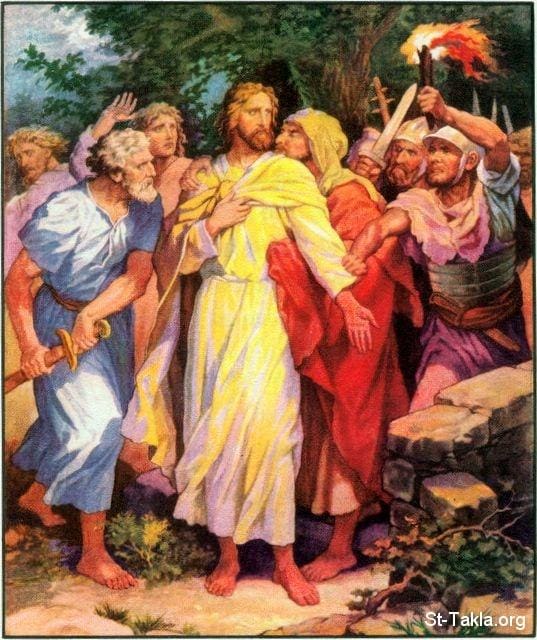
John 18 marks the beginning of Christ’s suffering leading to the cross. The Upper Room discourse has ended. The High Priestly Prayer has been offered. Now Jesus steps into the final hours before His crucifixion.
The chapter records four major events:
- The arrest of Jesus
- Peter’s denial
- Jesus before the Jewish authorities
- Jesus before Pilate
Throughout the chapter, one truth shines brightly: Jesus remains in complete control. Though He is arrested, questioned, and condemned, He is not a helpless victim. He is the willing Savior carrying out the Father’s plan of redemption.
Jesus Is Arrested in the Garden (John 18:1-11)
After leaving the Upper Room, Jesus crossed the Kidron Valley and entered a garden where He often met with His disciples.
Judas knew the location well.
Soon he arrived leading a detachment of soldiers and religious officials carrying lanterns, torches, and weapons.
Jesus Steps Forward
Rather than hiding, Jesus confronted the crowd.
“Whom seek ye?” (John 18:4)
They answered:
“Jesus of Nazareth.”
Jesus replied:
“I am he” (John 18:5).
The Greek expression echoes the divine name “I AM.”
At His words, the crowd drew back and fell to the ground.
This moment demonstrates Christ’s authority. The soldiers could not arrest Him unless He willingly surrendered Himself.
Protecting the Disciples
Jesus then requested:
“If therefore ye seek me, let these go their way” (John 18:8).
Even in the moment of His arrest, Jesus was protecting His followers.
Peter’s Rash Response
Peter drew a sword and struck the servant of the high priest, cutting off his right ear.
John identifies the servant as Malchus.
Jesus immediately rebuked Peter:
“Put up thy sword into the sheath” (John 18:11).
The kingdom of God would not be established by force.
Jesus willingly accepted the cup of suffering given by the Father.
Application
Jesus was never forced to the cross.
He willingly surrendered Himself out of love for sinners.
His sacrifice was voluntary, intentional, and redemptive.
Jesus Before Annas (John 18:12-24)
After His arrest, Jesus was taken first to Annas, the former high priest and father-in-law of Caiaphas.
Annas questioned Jesus about His disciples and teachings.
Jesus answered boldly:
“I spake openly to the world” (John 18:20).
Unlike conspirators who operate in secret, Jesus taught publicly.
Everything He taught could be examined and verified.
When an officer struck Him, Jesus calmly challenged the injustice:
“If I have spoken evil, bear witness of the evil” (John 18:23).
Even under mistreatment, Jesus remained composed and truthful.
Application
Believers can learn from Christ’s example when facing criticism or opposition.
Truth does not require anger or retaliation to defend itself.
Peter Denies Jesus (John 18:15-18, 25-27)
While Jesus was being questioned, Peter followed at a distance.
Three separate times people identified him as one of Jesus’ followers.
Three separate times Peter denied it.
First Denial
A servant girl asked:
“Art not thou also one of this man’s disciples?”
Peter answered:
“I am not” (John 18:17).
Second Denial
Others standing near the fire questioned him.
Again Peter denied knowing Jesus.
Third Denial
A relative of Malchus recognized Peter.
Surely this would expose him.
Yet Peter denied Christ a third time.
Immediately the rooster crowed.
Jesus’ prediction had come true.
Application
Peter’s failure reminds us of the danger of self-confidence.
Only hours earlier he had declared his willingness to die for Jesus.
Now he denied even knowing Him.
The Christian life requires dependence upon God’s strength rather than our own.
Jesus Before Pilate (John 18:28-38)
The Jewish leaders brought Jesus before the Roman governor, Pilate.
Because Rome controlled capital punishment, the religious leaders needed Pilate’s approval for execution.
Religious Hypocrisy
John notes an ironic detail.
The Jewish leaders refused to enter Pilate’s residence because they feared ceremonial defilement before Passover.
Yet at the same time they were plotting the death of the innocent Son of God.
Religious ritual had become more important to them than righteousness.
Pilate Questions Jesus
Pilate asked:
“Art thou the King of the Jews?” (John 18:33).
Jesus responded by explaining the nature of His kingdom.
“My kingdom is not of this world” (John 18:36).
His kingdom is real but spiritual, not political.
It advances through truth rather than military power.
The Purpose of Christ’s Mission
Jesus declared:
“For this cause came I into the world, that I should bear witness unto the truth” (John 18:37).
Everyone who loves truth listens to Christ.
Pilate then asked one of history’s most famous questions:
“What is truth?” (John 18:38).
Ironically, Truth Himself was standing before him.
Application
The world’s greatest need is not merely information but truth.
Jesus is not simply a teacher of truth; He is truth incarnate.
Barabbas Chosen Over Jesus (John 18:39-40)
Pilate concluded that Jesus was innocent.
Nevertheless, he offered the crowd a choice.
According to custom, one prisoner could be released at Passover.
Pilate expected the people to choose Jesus.
Instead they cried out:
“Not this man, but Barabbas” (John 18:40).
Barabbas was a robber and insurrectionist.
The innocent Savior was rejected while the guilty criminal was released.
A Picture of the Gospel
Barabbas serves as a powerful illustration of salvation.
The guilty man goes free.
The innocent man takes his place.
That is exactly what Jesus accomplishes for sinners.
He bears the punishment we deserve so that we can receive the freedom we do not deserve.
Application
Every believer is spiritually a Barabbas.
We stand guilty before God, yet Christ takes our place and offers us forgiveness.
Lessons from John 18
1. Jesus Was Always in Control
The arrest and trial unfolded according to God’s plan.
2. Christ Willingly Went to the Cross
His sacrifice was not forced but freely offered.
3. Human Strength Is Unreliable
Peter’s denial reminds us to depend upon God daily.
4. Religious Activity Cannot Replace Genuine Faith
The Jewish leaders were careful about ritual while ignoring righteousness.
5. Jesus Is the Truth
Truth is not merely a concept but a person.
6. The Gospel Is Substitution
Like Barabbas, sinners are set free because Christ takes their place.
Conclusion
John 18 begins the darkest hours of Jesus’ earthly ministry.
He is betrayed by Judas, abandoned by His disciples, denied by Peter, rejected by religious leaders, and questioned by Pilate.
Yet through every event, Jesus remains calm, purposeful, and obedient to the Father’s will.
The chapter reminds us that Calvary was not an accident. The arrest, trials, and suffering of Jesus were part of God’s plan to redeem sinners.
As the innocent Lamb of God stood condemned, He was taking the first steps toward the cross where He would bear the sins of the world.
And in the release of Barabbas, we see ourselves—a guilty people set free because Jesus willingly took our place.
<<Back to John 17 OR Foward to John 19>>
<<Back to Gospel of John
For more insights to the Gospel of John, order Pastor Alan’s book, Come and See, from the links below.
Dr. Alan Holden has served in pastoral ministry for more than 35 years, preaching and teaching the Bible in churches across the United States. He holds a Doctor of Ministry from Luther Rice Seminary and a Master of Divinity from The Southern Baptist Theological Seminary. Through What’s It Mean?, he seeks to help readers understand the meaning of Scripture and grow in their walk with Christ. He is currently the pastor of Lake Saunders Baptist Church in Tavares, FL.