







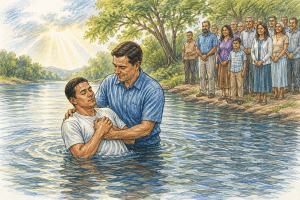
Baptism stands as one of the most recognizable practices of the Christian faith, yet many people misunderstand its purpose. Some believe baptism saves, while others dismiss it as little more than church tradition. Scripture presents a very different picture. Baptism is neither a magical ritual nor an optional ceremony. God ordained immersion as the public declaration that a person has trusted Jesus Christ as Lord and Savior (Key Scriptures: Matthew 28:19–20; Romans 6:3–5; Acts 2:38–41).
When believers enter the waters of baptism, they proclaim that their old life has ended and their new life in Christ has begun. They obey Christ, testify to their faith, and portray the Gospel through a powerful visual picture.
What Is Baptism?
The English word baptize comes from the Greek word baptizō, which means “to immerse,” “to dip,” or “to submerge.” In the New Testament, believers expressed their inward spiritual transformation by immersing themselves in water.
Water does not save anyone. Instead, immersion symbolizes what God has already accomplished in the believer’s heart through faith in Jesus Christ.
Immersion points to three great truths:
- Christ died for our sins.
- Christ was buried.
- Christ rose again.
Believers identify with Christ by going beneath the water, symbolizing His burial, and rising again, symbolizing their new life in Him.
Paul explained this truth:
“Therefore we are buried with him by baptism into death: that like as Christ was raised up from the dead…even so we also should walk in newness of life.” (Romans 6:4)
Why Did Jesus Command Baptism?
After His resurrection, Jesus gave His followers the Great Commission.
“Go ye therefore, and teach all nations, baptizing them in the name of the Father, and of the Son, and of the Holy Ghost.” (Matthew 28:19)
Notice the order:
- Make disciples.
- Baptize believers.
- Teach them to obey Christ.
Salvation comes first. Baptism follows.
Jesus Himself submitted to baptism—not because He needed forgiveness, but because He chose to fulfill the Father’s will and begin His public ministry (Matthew 3:13–17). If the sinless Son of God willingly obeyed in baptism, His followers should gladly obey Him as well.
Does Baptism Save?
Scripture consistently teaches that God saves sinners by grace through faith in Jesus Christ—not through works or religious ceremonies.
“For by grace are ye saved through faith…not of works.” (Ephesians 2:8–9)
If immersion were necessary for salvation, this passage would contradict itself.
The thief on the cross provides a clear example (Luke 23:39–43). He trusted Christ moments before his death, and Jesus promised him a place in Paradise. Although he never had the opportunity to be baptized, Jesus assured him of eternal life.
Cornelius and his household also received the Holy Spirit before they were baptized (Acts 10:44–48). God saved them first and immersed them afterward.
Baptism testifies to salvation; it does not produce salvation.
What Does Immersion Symbolize?
1. Death to the Old Life
When believers go beneath the water, they declare that Christ has buried their old sinful life.
They proclaim:
“My old sinful life no longer defines me.”
Christians still battle sin, but sin no longer rules them.
2. Resurrection to New Life
When believers rise from the water, they picture Christ’s resurrection and celebrate their new life in Him.
They now belong to Christ.
Their priorities begin to change.
New desires emerge.
The Holy Spirit continually transforms them into the likeness of Jesus.
3. Union with Christ
Immersion publicly identifies believers with Jesus Christ.
Paul wrote:
“For as many of you as have been baptized into Christ have put on Christ.” (Galatians 3:27)
Water baptism visibly portrays this spiritual union.
Baptism Is a Public Confession
Throughout the Book of Acts, believers publicly expressed their faith through immersion.
- Three thousand believers received baptism on the Day of Pentecost (Acts 2).
- The Ethiopian eunuch requested baptism immediately after believing (Acts 8).
- The Philippian jailer believed during the night and received baptism before morning (Acts 16).
No one treated immersion as a private or secret event.
Through immersion, believers openly declare:
“I belong to Jesus Christ.”
As opposition to biblical Christianity increases, believers continue to bear public witness through baptism.
Why Immersion?
The New Testament consistently presents immersion as the biblical pattern.
- John baptized where there was “much water” (John 3:23).
- Jesus came “up out of the water” after His baptism (Mark 1:10).
- Philip and the Ethiopian eunuch “went down both into the water” before the baptism (Acts 8:38–39).
Most importantly, immersion clearly portrays burial and resurrection.
Sprinkling cannot illustrate that biblical picture as completely as immersion.
Who Should Be Baptized?
The New Testament always places baptism after personal faith.
The biblical pattern remains consistent:
- Hear the Gospel.
- Believe in Christ.
- Receive baptism.
Every recorded immersion in Acts follows this sequence.
Because immersion expresses a believer’s personal confession of faith, Scripture does not present infant immersion as fulfilling Christ’s command. Infants cannot repent, believe, or personally confess Jesus Christ. The New Testament consistently practices believer’s baptism after an individual consciously trusts in Christ.
When Should Someone Be Baptized?
The New Testament shows believers receiving baptism soon after conversion.
Many trusted Christ and received baptism on the very same day.
Churches today may schedule immersions differently, but the principle remains:
Delayed obedience is still disobedience.
If you have trusted Christ but have never followed Him in baptism, Scripture gives you no reason to postpone this important act of obedience.
What Immersion Does Not Do
Scripture never teaches that baptism:
- Washes away sin.
- Earns forgiveness.
- Produces the new birth.
- Makes someone a Christian.
- Guarantees eternal life.
Jesus alone saves.
His blood alone cleanses sin.
Faith alone unites us with Him.
Immersion simply proclaims these glorious truths.
The Relationship Between Baptism and Church Membership
In the New Testament, immersion publicly identified believers with a local congregation.
Acts 2:41 declares:
“Then they that gladly received his word were baptized: and the same day there were added unto them about three thousand souls.”
Salvation joins believers to Christ’s universal body, while immersion publicly identifies them with Christ’s people in a local church.
God never intended Christians to live the Christian life alone.
Living Out Your Baptism
Immersion does not mark the finish line of the Christian life.
It marks the beginning of faithful discipleship.
Every day believers should live in a manner consistent with the testimony they declared in the baptistry.
If immersion proclaims, “I belong to Jesus,” then our speech, conduct, relationships, priorities, and worship should consistently reflect that confession.
Our daily lives should continue declaring what our baptism proclaimed once.
Conclusion
God gave baptism to His church as a beautiful gift. Through baptism, believers remember that Jesus died, was buried, and rose again for their salvation. They testify that God has forgiven them, made them new, and united them with Christ forever.
The waters of baptism do not save anyone—but they point every believer to the Savior who does.
If you have never trusted Jesus Christ as your Savior, begin with faith. Turn from your sin and place your trust in His finished work on the cross.
If you have trusted Christ but have never received immersion, obey His command with joy. Publicly declare what God has already accomplished in your heart.
Jesus said,
“If ye love me, keep my commandments.” (John 14:15)
Obedience begins with the first step, and for every believer, that first public step is immersion.
Frequently Asked Questions
Does salvation require baptism?
No. God saves us by grace through faith alone in Jesus Christ (Ephesians 2:8–9). Immersion follows salvation as an act of obedience.
Why should Christians be baptized?
Jesus commanded immersion, and it publicly identifies believers with His death, burial, and resurrection.
Should children be baptized?
Children who have personally trusted Christ and understand the meaning of immersion should receive baptism. The New Testament consistently presents believer’s baptism after a personal profession of faith.
What if I was baptized before I became a Christian?
If you received baptism before placing your faith in Christ, your baptism did not follow the New Testament pattern. After trusting Christ, you should receive believer’s baptism.
Can I be baptized more than once?
Generally, believers receive baptism only once. However, if someone received baptism before genuine faith in Christ or apart from believer’s baptism, many churches encourage baptism after conversion.
Key Takeaway
Baptism does not make us Christians. It declares that we already belong to Christ. Through baptism, believers joyfully and publicly testify to God’s saving grace and take their first step of obedience in a lifetime of following Jesus.
<<Back to the Teaching Library
Dr. Alan Holden has served in pastoral ministry for more than 35 years, preaching and teaching the Bible in churches across the United States. He holds a Doctor of Ministry from Luther Rice Seminary and a Master of Divinity from The Southern Baptist Theological Seminary. Through What’s It Mean?, he seeks to help readers understand the meaning of Scripture and grow in their walk with Christ. He is currently the pastor of Lake Saunders Baptist Church in Tavares, FL.