


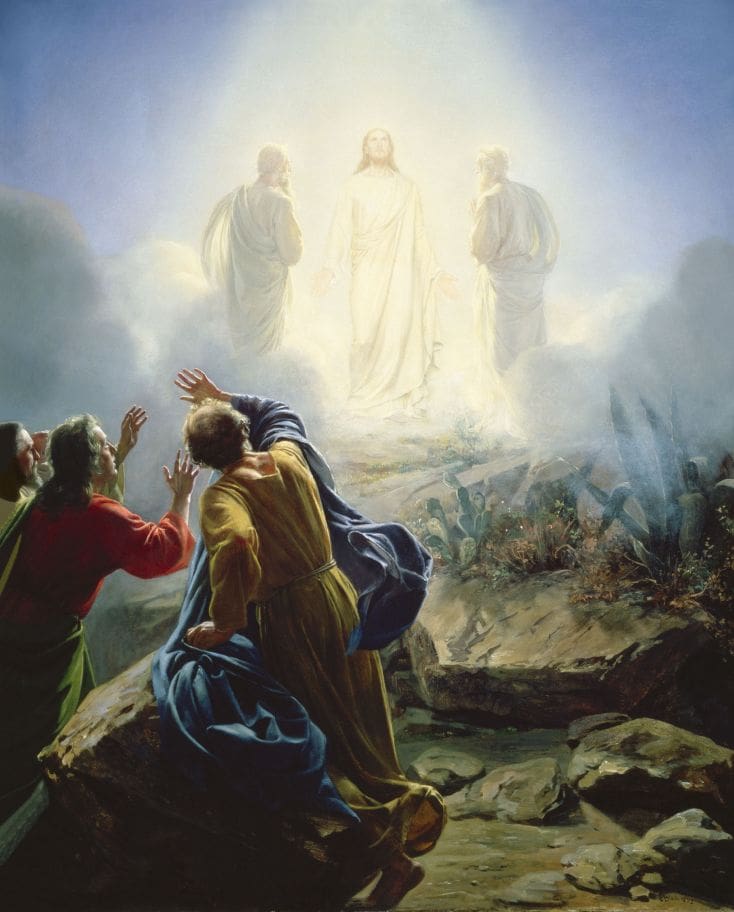
This work is in the public domain in its country of origin and other countries and areas where the copyright term is the author’s life plus 100 years or fewer. This work has been identified as being free of known restrictions under copyright law, including all related and neighboring rights.
Transfiguration: The Glory of Christ Revealed
Matthew 17:1–9
The Transfiguration of Jesus is one of the most majestic and revealing moments in the earthly ministry of Christ. For a brief moment, the veil of His humanity was drawn back, and His divine glory shone openly before chosen witnesses. This event was not merely spectacular—it was deeply theological, affirming who Jesus is and why His words must be heard above all others.
The Circumstances of the Transfiguration (Matthew 17:1)
The Time
Matthew records that the Transfiguration occurred six days after Jesus revealed to His disciples that He would soon suffer and die (Matthew 16:21). Luke’s Gospel mentions about eight days. The two accounts harmonize easily:
- The day Jesus revealed His death
- Six full days between
- The day of the Transfiguration
1 + 6 + 1 = 8 days
Rather than contradicting each other, the Gospel writers are measuring from slightly different reference points, much like we sometimes do today.
The Place — A Mountain
Scripture simply says “a high mountain,” though many identify it with Mount Miron. The exact location is less important than its symbolism:
- A solitary place — away from the crowds and distractions
- A sublime place — lifted above the world below
Mountains in Scripture often serve as meeting places between God and man. Elevation here reflects revelation.
The Witnesses — Peter, James, and John
Jesus chose three disciples to witness this moment. Their presence was not random.
- Jewish law established that truth is confirmed “in the mouth of two or three witnesses.”
- These three formed Christ’s inner circle.
They were present at:
- The raising of Jairus’ daughter (Mark 5:37)
- The Transfiguration
- The agony in the Garden of Gethsemane (Matthew 26)
They saw Christ’s power, glory, and suffering—a full spectrum of His mission.
The Manner of the Transfiguration (Matthew 17:2)
Matthew writes that “His face did shine as the sun.” Christ did not become something He was not; rather, He revealed what He always was. The servant’s veil was lifted, and the form of God shone through (Philippians 2:6).
Scripture repeatedly associates God with light:
- “God is light” (1 John 1:5)
- He “dwells in the light” (1 Timothy 6:16)
- He “covers Himself with light as with a garment” (Psalm 104:2)
Even His clothing became radiant. Matthew Henry observed that Moses’ reflected glory could be hidden behind a veil, but Christ’s glory emanated from within, illuminating even His garments. Moses reflected glory; Jesus possessed it.
The Companions of the Transfiguration (Matthew 17:3)
Two figures appeared beside Christ: Moses and Elijah.
Why Moses and Elijah?
They represent the Law and the Prophets, the entire Old Testament witness pointing to Christ. Their lives share remarkable parallels with Jesus:
- Both fasted forty days and nights.
- Both performed miracles.
- Both departed earthly life under mysterious circumstances.
Moses died but his burial place was never found, and Scripture even records a spiritual dispute over his body (Jude). Elijah was taken into heaven in a chariot of fire without tasting death.
Luke tells us they spoke with Jesus about His coming “decease”—literally, His exodus. Just as Moses led Israel out of bondage, Christ would soon lead humanity out of the bondage of sin through His death and resurrection.
Peter’s Confusion (Matthew 17:4)
Peter, overwhelmed, exclaimed, “Lord, it is good for us to be here,” and suggested building three tabernacles—one for each figure. His intention was sincere, but his understanding was flawed. By proposing equal honor, he unintentionally placed Jesus on the same level as Moses and Elijah. The moment required correction, and heaven responded immediately.
The Bright Cloud and the Voice (Matthew 17:5)
A bright cloud overshadowed them, and a voice declared:
“This is My beloved Son… Hear Him!”
Under the Old Covenant, God often appeared in thick darkness—at Sinai, in the temple, in scenes of awe and trembling. Here, under grace, the cloud is bright. The symbolism is profound:
- The Old Testament emphasized law, fear, and distance.
- The New Testament reveals light, love, and nearness.
The command “Hear Him” shifts authority unmistakably to Christ. The Law and the Prophets prepared the way; the Son is the final Word.
The Fright of the Disciples (Matthew 17:6–8)
The disciples fell on their faces in terror at the voice of God. Yet the same Jesus who shone with divine brilliance now approached them with tender compassion.
- What He did: He touched them.
- What He said: “Arise, and be not afraid.”
When they lifted their eyes, they saw only Jesus. Moses and Elijah left. The message was clear: prophets serve their time, but Christ remains forever. He is “the same yesterday, today, and forever” (Hebrews 13).
Conclusion
The Transfiguration proclaims several enduring truths:
- Jesus is God in human form. His glory is intrinsic, not borrowed.
- The saints live beyond death.
- Moses and Elijah were recognized by name, reminding us that identity continues in heaven.
- Two paths to glory are pictured:
- Moses represents believers who enter heaven through death.
- Elijah represents believers translated at Christ’s return.
- Above all, we must hear Jesus. His voice carries final authority.
The mountain scene fades, the cloud lifts, and the disciples descend—but they descend changed. They have seen the King in His beauty. The Transfiguration is not merely a spectacle of light; it is a revelation of supremacy. Christ is not one voice among many. He is the Beloved Son. And heaven’s command still stands:
“Hear Him!”