







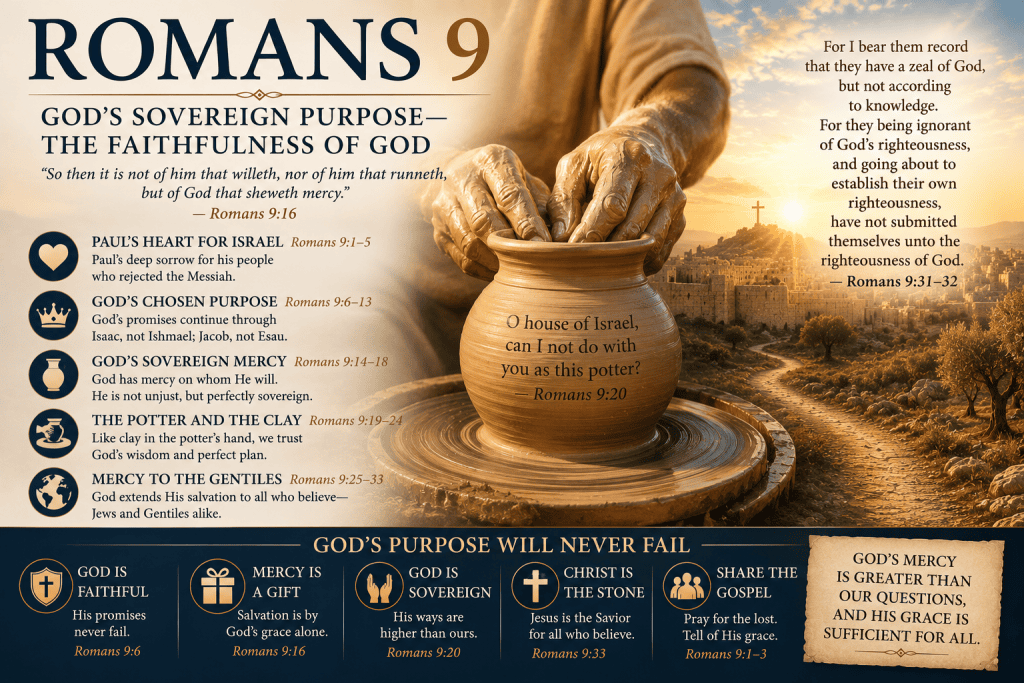
Romans 9 teaches that God is faithful to His promises and sovereign over His plan of redemption. Although many in Israel rejected Jesus as the Messiah, God’s Word has not failed. Salvation has always depended upon God’s mercy rather than human effort or religious heritage. This chapter calls believers to trust God’s wisdom, rejoice in His grace, and share Paul’s deep concern for those who have not yet believed in Christ.
“So then it is not of him that willeth, nor of him that runneth, but of God that sheweth mercy.” — Romans 9:16 (KJV)
Introduction
Romans 9 is one of the most challenging chapters in the Bible.
After celebrating the assurance of salvation in Romans 8, Paul turns his attention to a difficult question:
If Israel was God’s chosen nation, why have so many Jewish people rejected their Messiah?
Has God’s promise failed?
Has God abandoned Israel?
Paul’s answer is a resounding No!
Romans 9 reminds us that God is always faithful to His promises and always accomplishes His sovereign purposes. Even when we cannot fully understand His ways, we can trust His character.
This chapter calls us to stand in awe of God’s wisdom, mercy, and grace.
Paul’s Heart for His People (Romans 9:1–5)
Paul begins with one of the most emotional statements in all of his writings.
He says he has:
“Great heaviness and continual sorrow in my heart.”
Why?
Because many of his fellow Jews had rejected Jesus Christ.
Paul loved his people so deeply that he says, in effect, if it were possible, he would be willing to be cut off from Christ for their sake.
Of course, no one can take another person’s place in salvation.
Only Jesus could do that.
But Paul’s words reveal the heart of a true servant of God.
A Burden for the Lost
The greatest evidence of spiritual maturity is not theological knowledge alone.
It is a heart that longs to see people come to Christ.
Paul reminds us that it is possible to possess tremendous spiritual privileges and still miss the Savior.
Israel had received:
- The adoption
- The glory
- The covenants
- The Law
- The promises
- The patriarchs
- The Messiah according to the flesh
Yet many failed to believe.
Religious privilege is never a substitute for personal faith.
God’s Word Has Not Failed (Romans 9:6–13)
Paul immediately answers the obvious question.
If many Jews rejected Christ, had God’s promises failed?
He says:
“Not as though the word of God hath taken none effect.”
God’s promises remain true.
Paul explains that there has always been a distinction between physical descendants and the true people of faith.
Isaac, Not Ishmael
Abraham had more than one son.
Yet God chose Isaac as the child through whom His covenant promises would continue.
Jacob, Not Esau
Likewise, God chose Jacob rather than Esau to carry forward His covenant purposes.
Paul is emphasizing God’s sovereign choice in accomplishing His redemptive plan through history.
The focus here is not arbitrary favoritism but God’s freedom to fulfill His promises according to His own wisdom.
Is God Unfair? (Romans 9:14–18)
Whenever people hear about God’s sovereignty, they often ask:
“Is that fair?”
Paul asks the same question.
“Is there unrighteousness with God?”
His answer is immediate.
“God forbid.”
God is perfectly just.
He owes mercy to no one.
If mercy could be demanded, it would no longer be mercy.
Mercy Is a Gift
God said to Moses:
“I will have mercy on whom I will have mercy.”
Mercy is never earned.
Justice gives us what we deserve.
Mercy withholds the judgment we deserve.
Grace gives us blessings we could never earn.
Every believer is saved because God chose to show mercy through Jesus Christ.
That should produce humility rather than pride.
Pharaoh and God’s Glory (Romans 9:17–18)
Paul points to Pharaoh as an example.
Repeatedly, Pharaoh hardened his own heart against God.
Eventually, God confirmed Pharaoh in the path he had chosen.
Through Pharaoh’s rebellion, God demonstrated His power by delivering Israel from Egypt.
Even human rebellion cannot prevent God’s purposes.
God remains sovereign over history.
The Potter and the Clay (Romans 9:19–24)
Paul now uses one of Scripture’s most familiar illustrations.
God is the Potter.
We are the clay.
The clay does not tell the potter how to shape it.
The Creator has rights over His creation.
This illustration is not intended to make us fear God.
Rather, it reminds us that His wisdom is infinitely greater than ours.
When we cannot understand His ways, we can still trust His hands.
The Potter never makes mistakes.
God’s Mercy Extended to the Gentiles (Romans 9:25–29)
Paul quotes the Old Testament prophets to show that God’s plan always included bringing Gentiles into His family.
This should not have surprised Israel.
God had promised from the beginning that all nations would be blessed through Abraham.
At the same time, Paul reminds us that God always preserves a faithful remnant within Israel.
His promises to Israel have not been canceled.
They are unfolding according to His perfect timetable.
Israel Stumbled Over the Stumbling Stone (Romans 9:30–33)
Paul concludes by explaining why many Israelites failed to receive God’s righteousness.
The Gentiles received righteousness through faith.
Israel pursued righteousness through works.
That made all the difference.
Instead of trusting Christ, many trusted their own obedience.
Paul writes:
“They stumbled at that stumblingstone.”
Jesus became the stumbling stone because many refused to believe that salvation comes by grace rather than by human effort.
The lesson is just as relevant today.
People still try to earn what God freely offers.
The Gospel calls us to stop striving and start believing.
What Romans 9 Means for Us Today
Romans 9 teaches several important lessons.
Trust God’s Wisdom
There are aspects of God’s plan we may never fully understand.
His thoughts are higher than ours.
We can trust His character even when His ways remain mysterious.
Salvation Is by Grace
No one deserves God’s mercy.
Every believer is saved because of His grace through Jesus Christ.
That leaves no room for pride.
Pray for the Lost
Paul’s burden for Israel challenges us to care deeply for those who do not know Christ.
Sound theology should always produce compassionate evangelism.
Don’t Trust Religious Privileges
Growing up in church…
Owning a Bible…
Knowing Christian doctrine…
None of these save us.
Only personal faith in Jesus Christ brings salvation.
Living Romans 9
Ask yourself these questions this week:
- Do I trust God’s wisdom even when I cannot understand His plans?
- Am I grateful for God’s mercy rather than assuming I deserve it?
- Do I have Paul’s burden for people who are without Christ?
- Am I trusting God’s grace or relying on my own efforts?
- How can I demonstrate humility in light of God’s mercy?
Faith grows strongest when it rests in God’s character rather than our understanding.
Final Thoughts
Romans 9 reminds us that God’s plans never fail.
Though Israel largely rejected Christ, God’s promises remain secure.
His sovereign purposes continue to unfold exactly as He has declared.
At the same time, this chapter reveals the amazing mercy of God.
No one deserves salvation.
Yet God extends His grace freely through Jesus Christ to everyone who believes.
Instead of arguing with God’s wisdom, Romans 9 invites us to worship Him.
The God who rules history is also the God who sent His Son to save sinners.
His sovereignty does not diminish His love.
It magnifies it.
And because He is faithful, we can trust Him completely.
Enjoy simple, Bible-centered teaching? Receive a short Daily Devotion by email and spend a few minutes each day in God’s Word. For more information, CLICK HERE.
Continue studying Romans: Explore our complete chapter-by-chapter guide to the Book of Romans, including humanity’s sin to Christ’s sacrifice, from justification by faith to the victorious Christian life in the Spirit, and the law of love–OR go:
<<Back to Romans 8 OR Forward to Romans 10>>
<<Back to Bible Passages
Want to do a deeper dive in the study of Romans? Get my book, Romans: The Glory of the Gospel and the Obedience of Faith, by making your choice of platforms below:
Dr. Alan Holden has served in pastoral ministry for more than 35 years, preaching and teaching the Bible in churches across the United States. He holds a Doctor of Ministry from Luther Rice Seminary and a Master of Divinity from The Southern Baptist Theological Seminary. Through What’s It Mean?, he seeks to help readers understand the meaning of Scripture and grow in their walk with Christ. He is currently the pastor of Lake Saunders Baptist Church in Tavares, FL.