







Romans 11 teaches that God has not abandoned Israel and that His covenant promises remain faithful. During this present age, God is gathering believers from every nation through the Gospel, yet He still has future purposes for Israel. Salvation comes entirely by grace, leaving no room for pride. The chapter concludes by calling believers to marvel at God’s infinite wisdom, mercy, and faithfulness, responding with humble worship and complete trust.
“For the gifts and calling of God are without repentance.” — Romans 11:29 (KJV)
Introduction
Has God finished with Israel?
Because many Jewish people rejected Jesus as their Messiah, some have concluded that God permanently rejected the nation of Israel and transferred all of His promises to the Church.
Romans 11 answers that question with unmistakable clarity.
Paul declares:
“God forbid.” (Romans 11:1)
God has not cast away His people.
Romans 11 reveals the amazing wisdom of God’s plan of redemption. During the present Church Age, the Gospel has gone out to the Gentiles, but God still has a future purpose for Israel. His promises have not failed, His covenant has not been broken, and His faithfulness remains unchanged.
Above all, this chapter reminds us that God’s mercy extends farther than we can imagine.
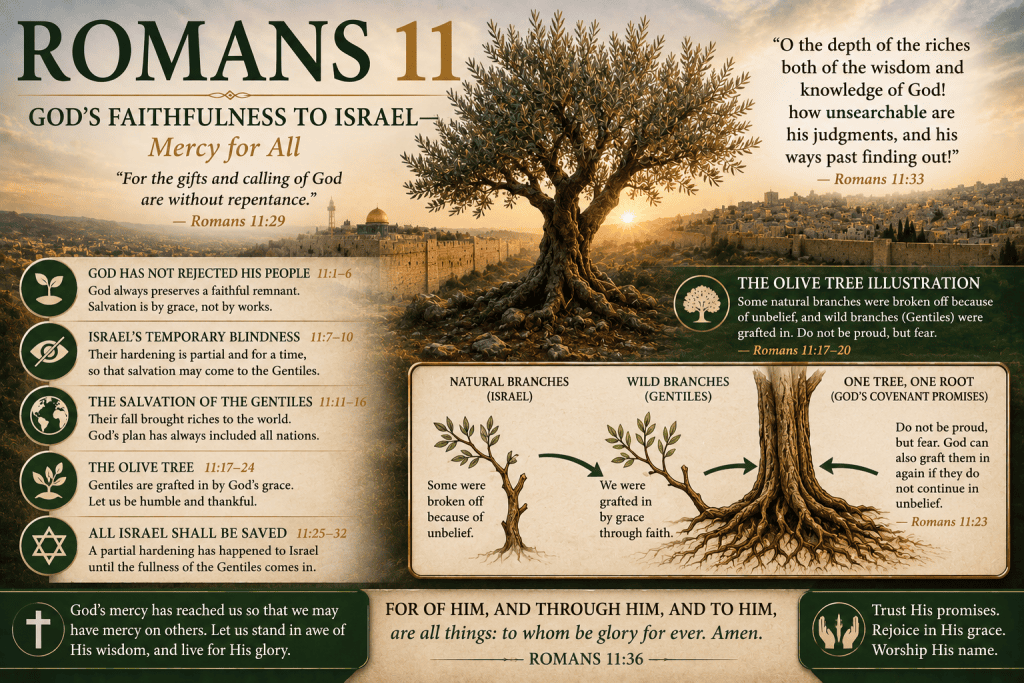
God Has Not Rejected His People (Romans 11:1–6)
Paul begins by asking:
“Hath God cast away his people?”
His answer is immediate.
“God forbid.”
Paul offers himself as proof.
He was:
- A Jew
- A descendant of Abraham
- A member of the tribe of Benjamin
If God had rejected Israel completely, Paul himself could not have been saved.
The Example of Elijah
Paul reminds his readers of Elijah’s discouragement.
The prophet believed he was the only faithful believer left in Israel.
God corrected him.
There were still seven thousand who had not bowed to Baal.
God always preserves a faithful remnant.
The same was true in Paul’s day.
Though many rejected Christ, thousands of Jewish believers had trusted Him.
God’s promises remained intact.
Grace, Not Works (Romans 11:5–6)
Paul reminds us again:
“There is a remnant according to the election of grace.”
Salvation has always been based upon grace.
If salvation depended upon works, it would no longer be grace.
These two systems cannot be mixed.
We either trust our own efforts…
Or we trust God’s mercy.
The Gospel invites us to rest completely in the finished work of Jesus Christ.
Israel’s Temporary Blindness (Romans 11:7–10)
Paul explains that many Israelites became spiritually hardened because they rejected their Messiah.
This blindness, however, is temporary, not permanent.
God’s judgment is always righteous.
Yet even in judgment, His mercy remains at work.
The rejection of Christ by many in Israel became the means by which the Gospel spread rapidly throughout the Gentile world.
What appeared to be defeat became part of God’s greater plan.
Salvation Comes to the Gentiles (Romans 11:11–16)
Paul asks another question.
“Have they stumbled that they should fall?”
Again he answers:
“God forbid.”
Israel stumbled.
But God had not abandoned them.
Instead, He used Israel’s rejection to bring salvation to the Gentiles.
God’s Larger Purpose
As Gentiles came to faith in Christ, Paul hoped Israel would see God’s blessings and be stirred to seek their own Messiah.
God’s plan was never limited to one nation.
From the beginning, He promised Abraham:
“In thee shall all families of the earth be blessed.”
The Gospel fulfills that promise.
The Olive Tree (Romans 11:17–24)
Paul now uses the illustration of an olive tree.
The natural branches represent Israel.
Wild branches represent believing Gentiles who have been brought into God’s covenant blessings.
Paul gives Gentile believers an important warning.
Do not become proud.
The branches do not support the root.
The root supports the branches.
Everything believers possess comes by God’s grace.
Humility Is Essential
There is never room for arrogance in the Christian life.
We were not chosen because we deserved God’s favor.
We stand only because of His mercy.
Humility should characterize everyone who has received God’s grace.
All Israel Shall Be Saved (Romans 11:25–32)
Paul now reveals what he calls a mystery.
Israel’s hardening is partial and temporary.
It will continue:
“Until the fulness of the Gentiles be come in.”
Then Paul declares:
“And so all Israel shall be saved.”
This points to a future national turning of Israel to Jesus Christ.
The prophets repeatedly foretold such a day.
God’s covenant promises remain certain because:
“The gifts and calling of God are without repentance.”
God never breaks His promises.
His faithfulness does not depend upon human faithfulness.
He always accomplishes His purposes.
A Song of Praise (Romans 11:33–36)
Paul cannot finish this chapter without worship.
After contemplating God’s wisdom, mercy, and sovereignty, he bursts into praise.
“O the depth of the riches both of the wisdom and knowledge of God!”
Some questions cannot be fully answered.
Some mysteries remain.
But every mystery should lead us to greater worship.
Paul reminds us:
God’s wisdom is perfect.
His knowledge is complete.
His purposes never fail.
Then he concludes:
“For of him, and through him, and to him, are all things: to whom be glory for ever.”
Everything begins with God; everything exists through God; and everything ultimately points back to God.
What Romans 11 Means for Us Today
Romans 11 offers several practical lessons.
God Always Keeps His Promises
When circumstances seem confusing, remember:
God never abandons His Word.
What He promises, He fulfills.
Beware of Spiritual Pride
Everything we possess spiritually has been given by grace.
Gratitude leaves no room for arrogance.
God’s Mercy Is Amazing
Paul reminds us that God extends mercy to both Jews and Gentiles.
No one deserves salvation.
Everyone who believes receives it by grace.
Worship the God You Cannot Fully Explain
There are truths about God’s plan that exceed our understanding.
Rather than producing doubt, they should produce wonder.
The more we learn about God, the more we should worship Him.
Living Romans 11
Ask yourself these questions this week:
- Am I trusting God’s promises even when I cannot see how He is working?
- Is gratitude replacing pride in my walk with Christ?
- Do I rejoice that God’s mercy extends to people from every nation?
- Am I praying for the salvation of Israel and for all people who do not yet know Christ?
- Does studying God’s Word lead me to greater worship?
God’s faithfulness deserves more than our admiration.
It deserves our complete trust.
Final Thoughts
Romans 11 brings Paul’s discussion of Israel to a magnificent conclusion.
God has not rejected His people.
His promises remain secure.
His plan continues to unfold exactly as He intended.
The same God who showed mercy to Gentiles will one day complete His purposes for Israel.
More importantly, Romans 11 reminds every believer that salvation is entirely the work of God’s grace.
No one can boast.
No one can claim credit.
Everything we have comes from His mercy.
As Paul finishes this chapter, he does not end with an argument.
He ends with worship.
May we do the same.
The God whose wisdom is beyond searching is also the God whose love reached us through Jesus Christ.
To Him belongs all glory forever.
Amen.
Enjoy simple, Bible-centered teaching? Receive a short Daily Devotion by email and spend a few minutes each day in God’s Word. For more information, CLICK HERE.
Continue studying Romans: Explore our complete chapter-by-chapter guide to the Book of Romans, including humanity’s sin to Christ’s sacrifice, from justification by faith to the victorious Christian life in the Spirit, and the law of love–OR go:
<<Back to Romans 10 OR Forward to Romans 12>>
<<Back to Bible Passages
Want to do a deeper dive in the study of Romans? Get my book, Romans: The Glory of the Gospel and the Obedience of Faith, by making your choice of platforms below:
Dr. Alan Holden has served in pastoral ministry for more than 35 years, preaching and teaching the Bible in churches across the United States. He holds a Doctor of Ministry from Luther Rice Seminary and a Master of Divinity from The Southern Baptist Theological Seminary. Through What’s It Mean?, he seeks to help readers understand the meaning of Scripture and grow in their walk with Christ. He is currently the pastor of Lake Saunders Baptist Church in Tavares, FL.