


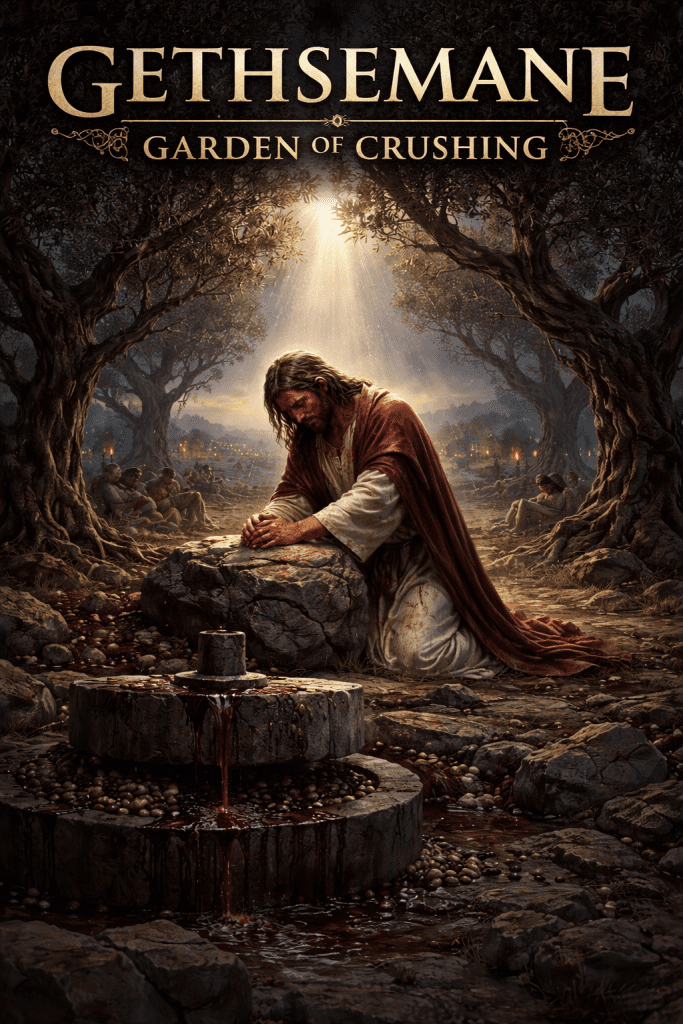
The Garden of Crushing
Matthew 26:36–46
In the closing hours before His arrest, Jesus entered a quiet olive grove outside Jerusalem known as Gethsemane. What appeared to be a secluded place of prayer was, in reality, the scene of profound spiritual conflict. Here, beneath the shadow of ancient trees, the Son of God bore the crushing weight of humanity’s sin. Jesus prayed in the Garden of Gethsemane because He felt the full burden of what lay ahead—the suffering, the separation, and the sacrifice required to redeem the world.
The Place
Verse 36 tells us that Jesus came with His disciples “unto a place called Gethsemane.” The name Gethsemane means “olive press.” In ancient times, olives were crushed under heavy stones until precious oil flowed out. The symbolism is striking. In this garden, the Lord Jesus would be spiritually pressed and bruised so that the oil of salvation might flow freely to all who believe.
Scripture repeatedly notes significant events occurring in “a place called…” as if God is marking the path of redemption with divine signposts:
- Jesus was betrayed in a place called Gethsemane (Matthew 26:36).
- He was condemned in a place called Gabbatha (John 19:13).
- He was crucified in a place called Golgotha (John 19:17).
- He was buried in a garden (John 19:41).
- Now, He has gone to prepare a place for His people in heaven (John 14:3).
From the olive press to the eternal dwelling, the journey of Christ reveals God’s deliberate plan to rescue sinners and prepare a home for the redeemed.
The Company — Verses 36–37
Jesus did not enter the garden alone. Eleven disciples accompanied Him, though Judas had already departed to betray Him. At the entrance, Jesus left most of the disciples and took Peter, James, and John farther into the garden. These three had witnessed His glory on the Mount of Transfiguration; now they would glimpse His sorrow in Gethsemane.
He instructed them, “Tarry here, and watch with Me.” Yet even with close friends nearby, Jesus walked farther still to pray alone. There are moments in life—and certainly in redemption—where no human companion can fully share the burden. The Savior faced the deepest anguish of His mission in solitude.
The Agony — Verse 38
Matthew records that Jesus began to be “sorrowful and very heavy,” declaring, “My soul is exceeding sorrowful, even unto death.” Luke adds that His sweat became like great drops of blood falling to the ground (Luke 22:44). This was not mere fear of physical pain. Many martyrs have faced death with calm resolve. Christ’s agony reached deeper.
In Gethsemane, Jesus confronted the spiritual horror of bearing the sins of the world. He foresaw:
- The treachery of Judas.
- The denials of Peter.
- The malice of religious leaders.
- The cruelty of Roman execution.
More than these, He anticipated the moment when He would carry humanity’s iniquity and experience the righteous judgment of God against sin. Jesus engaged the powers of darkness (Luke 22:53), standing at the threshold of the cross where divine justice and divine mercy would meet.
Jesus returned to His disciples and found them asleep. He had asked them to watch; instead, they slumbered. His soul was in agony, even unto death, yet their eyes were heavy. The contrast is sobering—Christ alert and burdened, His followers unaware and weary.
The Petition — Verse 39
Jesus then withdrew again to pray. The gospel writer describes His posture: “He fell on His face.” This is the posture of total surrender and deep humility. His prayer reveals both His humanity and His obedience:
- His title for God: “O My Father!”
- His request: “If it be possible, let this cup pass from Me.”
- His submission: “Nevertheless, not as I will, but as Thou wilt.”
The “cup” symbolized the full measure of suffering and divine wrath against sin. Jesus did not rebel against the Father’s will; rather, He expressed the genuine anguish of His human nature while perfectly submitting to the divine plan. He prayed this prayer three times. The first time He asked if the cup might pass. By the second and third prayers, His words reflected full acceptance. The struggle moved from anguish to resolve. The pressing produced obedience; the crushing released redemption.
The Rebuke — Verses 40–41
Returning again, Jesus found the disciples asleep. Their failure was simple yet serious: they slept when they should have prayed. Yet Christ’s response was correction and compassion.
He rebuked them gently: “Could ye not watch with Me one hour?”
He counseled them wisely: “Watch and pray, that ye enter not into temptation.”
He excused them kindly: “The spirit indeed is willing, but the flesh is weak.”
Though disappointed, He did not cast them aside. He understood human frailty. Even in His deepest sorrow, He extended grace. The lesson is timeless—spiritual vigilance requires prayer, for good intentions alone cannot overcome weak flesh.
The Trial Begins — Verses 45–46
Finally, Jesus declared, “The hour is at hand… Rise, let us be going.” The time for prayer had prepared Him for the time of suffering. The disciples, who slept instead of praying, would soon scatter in fear. Christ, who prayed instead of sleeping, stood ready to face betrayal, arrest, and crucifixion.
The garden reveals a powerful truth: Christ was prepared because He prayed. The disciples were unprepared because they slept. Prayer did not remove the cross, but it strengthened the Savior to endure it. In Gethsemane, the Son of God accepted the crushing load of sin so that sinners might receive the oil of salvation. The olive press of sorrow became the birthplace of hope.
What took place in that quiet garden echoes through eternity. There, Jesus chose obedience over escape, submission over resistance, and love over self-preservation. Because He endured the crushing, all who trust Him may experience forgiveness, peace, and the promise of a prepared place with Him forever.
Oh my goodness what a beautiful explanation and picture you have painted for us with this one. Makes my heart so thankful that Jesus was human and knew we must have His Spirit dwelling within us to survive this world and join Him for eternity. Thank you Pastor Alan
Thank you for your kind words. It really does mean a lot to me.
Brother I am too blessed after reading your article.
1. Jesus crushed for salvation oil.
2. Jesus prepared for next because he stay in prayers.
3. I need to stay prayerful life for blessings and work with Him.
I also thankful to you for this blessed teaching.
Pastor Patras Prince from Pakistan
Thank you for your kind words. It means a lot to me.