







Genesis 28 — Jacob’s Ladder: Surely the LORD Is in This Place
Key Scriptures: Genesis 28:1–22; John 1:47–51; Hebrews 13:5–6; Psalm 121:1–8
“Surely the LORD is in this place; and I knew it not.” — Genesis 28:16
Genesis 28 begins with Jacob leaving home.
He deceived his father.
He took Esau’s blessing.
Now Esau wanted to kill him.
Therefore, Jacob was running.
He left behind:
- his father.
- his mother.
- his brother.
- his home.
- his security.
He did not know when—or whether—he would return.
However, Jacob was about to discover something that would change his life:
He could leave home, but he could not leave God’s presence.
At Bethel, God met Jacob in the middle of nowhere.
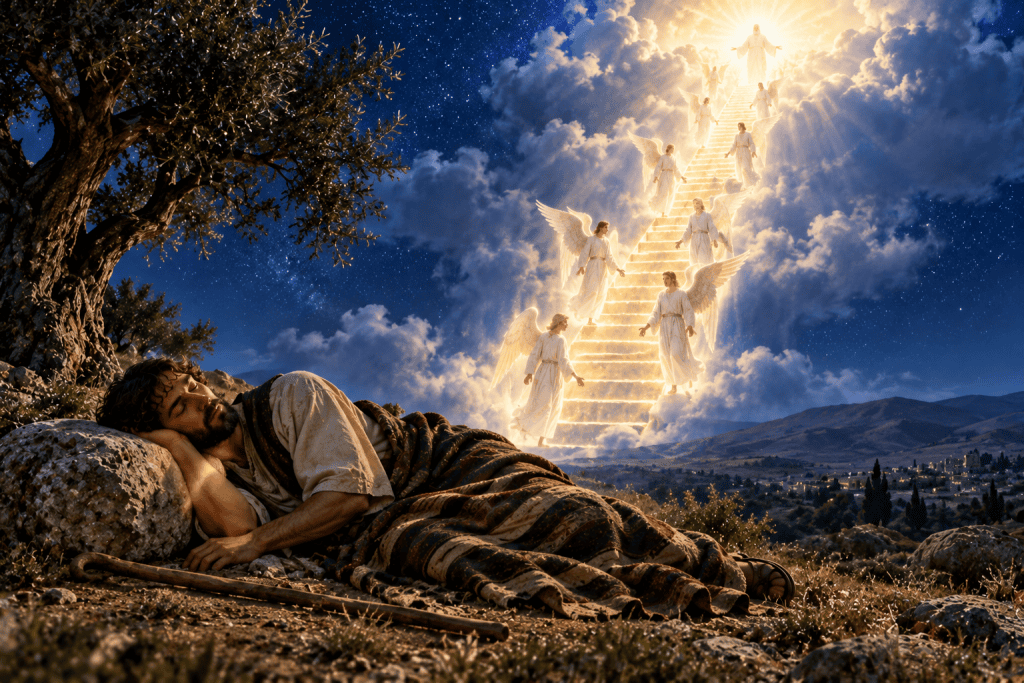
There Jacob saw a ladder reaching from earth to heaven.
More importantly, he heard God speak.
The God of Abraham and Isaac was becoming the God of Jacob.
Isaac Blessed Jacob Again
Genesis 28 begins with Isaac calling Jacob.
This time there was no disguise:
- No goatskin.
- No deception.
- No stolen identity.
Isaac knowingly blessed Jacob.
He told him:
“Thou shalt not take a wife of the daughters of Canaan.” — Genesis 28:1
Instead, Jacob was to travel to Padan-aram and find a wife among Rebekah’s relatives.
Then Isaac said:
“And God Almighty bless thee, and make thee fruitful, and multiply thee.” — Genesis 28:3
Furthermore, Isaac specifically passed along:
“The blessing of Abraham.”
This is important.
In Genesis 27, Jacob obtained the blessing through deception.
Now Isaac knowingly confirms the covenant blessing.
God’s purpose concerning Jacob stands.
Jacob Did Not Need the Deception
This raises an obvious point.
If Isaac ultimately gave Jacob the covenant blessing willingly, then all the deception in Genesis 27 had been unnecessary.
Rebekah did not need to manipulate.
Jacob did not need to lie.
God was fully capable of accomplishing what He had promised.
That remains an important lesson.
Sin is never necessary to accomplish God’s will.
We may think:
- “If I don’t force this, it will never happen.”
- “If I tell the whole truth, I may lose the opportunity.”
- “If I don’t manipulate this situation, things will go wrong.”
However, God does not need our dishonesty to fulfill His purposes.
Esau Saw What Pleased His Father
Esau noticed that Isaac did not approve of Canaanite wives.
Therefore, he married a daughter of Ishmael.
Apparently, Esau was trying to gain his father’s approval.
However, his response still missed the deeper spiritual issue.
External adjustments cannot substitute for a changed heart.
It is possible to modify our behavior without truly surrendering ourselves to God.
Therefore, spiritual life must involve more than asking:
“What will make people approve of me?”
The greater question is:
“What honors God?”
Jacob Left Beersheba
Genesis 28:10 says:
“And Jacob went out from Beersheba, and went toward Haran.”
That simple sentence marks a major transition.
Jacob had lived surrounded by family.
Now he was alone.
Previously, Rebekah had helped arrange things for him.
Now she was not there.
Previously, Jacob lived in tents.
Now he was sleeping outside.
The man who had grasped for control was entering circumstances he could not control.
Sometimes God uses unfamiliar places to teach us dependence.
Jacob Came to a Certain Place
As night approached, Jacob stopped:
“Upon a certain place.”
Genesis does not initially describe it as a sacred place.
There was no temple, no altar, no religious gathering, and no priest.
As far as Jacob knew, it was simply a convenient place to spend the night.
He took a stone and used it for a pillow.
Then he lay down to sleep.
Jacob did not know it yet, but his ordinary stopping place was about to become Bethel—the house of God.
God Meets Us in Unexpected Places
We sometimes imagine that God only meets people in obviously religious settings.
Certainly, God meets us in worship.
God speaks through Scripture.
He works through His church.
However, God is not confined to a church building.
The Lord met Moses beside a burning bush.
He met Elijah in a cave.
God met Paul on the road to Damascus.
And He met Jacob while Jacob slept outdoors with a stone near his head.
Therefore, never assume God cannot meet you where you are.
Jacob Dreamed
Genesis 28:12 says:
“And he dreamed, and behold a ladder set up on the earth, and the top of it reached to heaven.”
Then:
“Behold the angels of God ascending and descending on it.”
What a sight!
Earth below.
Heaven above.
A ladder connecting the two.
Angels moving between heaven and earth.
Jacob had probably felt completely alone.
However, the dream revealed an unseen spiritual reality.
He was not alone at all.
Heaven Was Not Far Away
Jacob’s circumstances suggested separation.
He was:
- far from home.
- separated from his family.
- traveling toward an uncertain future.
Nevertheless, heaven had not lost track of him.
God knew exactly where Jacob was.
That is encouraging.
There are moments when God seems distant because our circumstances are difficult.
However, God’s apparent silence does not mean His absence.
The unseen God is still present.
The LORD Stood Above It
Genesis 28:13 says:
“And, behold, the LORD stood above it.”
The greatest part of Jacob’s dream was not the ladder or the angels.
It was the LORD.
Jacob was about to learn that the God his grandfather worshiped and the God his father worshiped was speaking directly to him.
God said:
“I am the LORD God of Abraham thy father, and the God of Isaac.”
Then God repeated the covenant promise.
God Repeated the Promise
God promised Jacob the land.
He promised descendants.
“Thy seed shall be as the dust of the earth.” — Genesis 28:14
Then He repeated the promise first given to Abraham:
“And in thee and in thy seed shall all the families of the earth be blessed.”
The covenant line now clearly continued through Jacob.
Eventually, Jacob’s descendants would become the nation of Israel.
And ultimately, through that nation would come Jesus Christ.
Grace Met Jacob Before Jacob Deserved It
Think about when this encounter occurred.
Jacob had:
- just deceived his father.
- lied repeatedly.
- manipulated his brother.
He was running because his family was falling apart.
Yet God appeared to him.
That is grace.
God did not appear because Jacob had finally earned His attention.
The Lord came because God had chosen to extend His covenant grace.
This does not excuse Jacob’s sins.
He will experience painful consequences for them.
Nevertheless, God’s grace reaches people while they are still deeply flawed.
God Said, “I Am With Thee”
Then came one of the greatest promises in Genesis:
“And, behold, I am with thee.” — Genesis 28:15
Jacob had left nearly everyone he knew.
But God said:
“I am with thee.”
Then:
“And will keep thee in all places whither thou goest.”
Jacob did not know what awaited him in Haran.
But God did.
Jacob did not know Laban would deceive him.
But God did.
Jacob did not know he would remain away from home for about twenty years.
But God did.
Nevertheless:
“I am with thee.”
God Promised to Bring Jacob Home
God continued:
“And will bring thee again into this land.”
Jacob was leaving Canaan.
However, God promised he would return.
Then God said:
“For I will not leave thee, until I have done that which I have spoken to thee of.”
Jacob’s future did not depend entirely upon Jacob’s ability to navigate every difficulty.
It rested upon God’s faithfulness.
God essentially said:
“I started this, and I will finish it.”
“I Will Not Leave Thee”
This promise echoes throughout Scripture.
God later told Israel:
“I will never leave thee, nor forsake thee.” — Hebrews 13:5
Jesus promised His disciples:
“Lo, I am with you alway, even unto the end of the world.” — Matthew 28:20
Therefore, Jacob’s experience reflects a truth believers still need.
Our circumstances change.
People come and go.
Health changes.
Jobs change.
Homes change.
Relationships change.
Life changes.
But God remains.
Jacob Woke Up
When Jacob awoke, he said:
“Surely the LORD is in this place; and I knew it not.” — Genesis 28:16
That is one of the most memorable statements in Genesis.
Notice what Jacob did not say.
He did not say:
“God just arrived.”
Instead:
“The LORD is in this place; and I knew it not.”
God had been there before Jacob recognized Him.
God Can Be Working Before We Recognize Him
This is one of the great truths of providence.
Sometimes we look back on a difficult season and realize:
God was there.
At the time, we could not see it.
We thought nothing was happening.
Then we thought we were alone.
And we wondered why God seemed silent.
Later, however, we see His hand.
The:
- person He sent.
- door He closed.
- opportunity He opened.
- strength He gave.
- protection we did not recognize.
Then we say with Jacob:
“Surely the LORD was in this place, and I knew it not.”
Jacob Was Afraid
Genesis 28:17 says:
“And he was afraid.”
This was not merely terror.
Jacob was overwhelmed by the holiness and reality of God’s presence.
He said:
“How dreadful is this place!”
The word carries the idea of awe.
Then Jacob said:
“This is none other but the house of God, and this is the gate of heaven.”
The ordinary place had become extraordinary because Jacob had encountered God there.
Jacob Set Up the Stone
Early the next morning, Jacob took the stone he had used and set it up as a pillar.
Then he poured oil upon it.
This became a memorial.
Jacob wanted to remember what had happened.
That is a helpful spiritual practice.
We forget easily.
Therefore, Scripture repeatedly encourages God’s people to remember:
- answered prayers.
- times of provision.
- God’s faithfulness.
- lessons learned in difficult seasons.
Spiritual memorials help us remember what fear tries to make us forget.
Jacob Called the Place Bethel
The place had previously been called Luz.
Jacob renamed it:
Bethel.
The name means:
House of God.
Nothing about the geography had changed.
The rocks were still there and the landscape was still there.
But Jacob had changed.
He now understood that God had met him there.
Sometimes the place we would never have chosen becomes the place where we learn something about God we desperately needed to know.
Hard Places Can Become Holy Places
Jacob probably would not have chosen to leave home under these circumstances.
He would not have chosen conflict with Esau.
Jacob would not have chosen to sleep outside alone.
Nevertheless, the difficult place became Bethel.
That does not mean every painful circumstance is good.
However, God can meet us in painful circumstances and accomplish good through them.
Therefore, do not waste the wilderness.
Ask:
“Lord, what do You want to teach me here?”
Jacob Made a Vow
Jacob then made a vow.
He said:
“If God will be with me, and will keep me in this way that I go… Then shall the LORD be my God.” — Genesis 28:20–21
At first glance, Jacob’s words may sound conditional.
God had already promised to be with him.
Yet Jacob still seemed to be learning how to trust that promise personally.
This fits Jacob’s spiritual development.
He was not yet the mature Israel we will meet later.
He was beginning his own walk with God.
Faith Often Grows Gradually
Jacob’s life reminds us that spiritual maturity usually takes time.
Abraham’s faith grew over decades.
Jacob’s would too.
God meets us where we are.
Then He patiently changes us.
We may wish transformation happened instantly.
Sometimes it does.
More often, God shapes us through years of experiences, failures, correction, blessings, and grace.
Therefore, do not become discouraged because you are still growing.
Keep walking with God.
Jacob Promised a Tenth
Jacob also said:
“And of all that thou shalt give me I will surely give the tenth unto thee.” — Genesis 28:22
His response acknowledged that whatever he possessed ultimately came from God.
Abraham had previously given a tenth to Melchizedek.
Now Jacob expressed a similar commitment.
Generosity grows naturally when we recognize God as the source of our provision.
Jacob’s Ladder and Jesus Christ
Genesis 28 becomes even more important when we turn to the Gospel of John.
Jesus spoke to Nathanael and said:
“Hereafter ye shall see heaven open, and the angels of God ascending and descending upon the Son of man.” — John 1:51
Jesus deliberately used the language of Jacob’s dream.
In Genesis, Jacob saw the ladder connecting heaven and earth.
In John, Jesus identifies Himself as the true connection between heaven and earth.
Jesus Is the Way to Heaven
Jacob saw a ladder.
Jesus said:
“I am the way, the truth, and the life: no man cometh unto the Father, but by me.” — John 14:6
We do not:
- climb to God through religious achievement.
- reach heaven through good works.
- build our own spiritual ladder.
Instead, God came down to us in Jesus Christ.
Jesus is the Mediator.
He is the way.
Jesus brings God and sinners together.
Babel and Bethel
There is also an interesting contrast earlier in Genesis.
At Babel, humanity tried to build a tower:
“Whose top may reach unto heaven.” — Genesis 11:4
Human beings tried to reach heaven through their own achievement.
The result was confusion and scattering.
At Bethel, Jacob did not build anything to reach heaven.
God provided the connection.
That is the difference between human religion and divine grace.
Religion says:
“I will climb my way to God.”
Grace says:
“God has come down to me.”
What Genesis 28 Means for Us
1. God Does Not Need Our Sinful Help
Jacob received the covenant blessing openly from Isaac.
Therefore, the deception of Genesis 27 had been unnecessary.
Trust God without manipulation.
2. God Meets Us in Unexpected Places
Jacob met God while sleeping outdoors.
Therefore, never assume your present circumstances are beyond God’s reach.
3. God Is Present Even When We Do Not Recognize Him
Jacob said:
“Surely the LORD is in this place; and I knew it not.”
God may be working even when we cannot see Him.
4. Grace Comes to Imperfect People
Jacob had serious character problems.
Nevertheless, God met him.
Grace does not wait until we have perfected ourselves.
5. God’s Presence Is Greater Than Our Loneliness
Jacob left home alone.
However, God said:
“I am with thee.”
Believers are never truly abandoned.
6. God Keeps His Promises
God promised to protect Jacob and bring him home.
Therefore, Jacob’s future rested upon God’s faithfulness.
7. Difficult Places Can Become Places of Spiritual Growth
Jacob’s lonely stopping place became Bethel.
Therefore, God can use unwanted seasons to teach us important truths.
8. Remember What God Has Done
Jacob erected a memorial.
Likewise, remembering past faithfulness strengthens present faith.
9. Spiritual Growth Takes Time
Jacob was beginning a long journey of transformation.
Therefore, keep walking even when growth seems slow.
10. Jesus Is the True Way Between Heaven and Earth
Jacob saw a ladder.
Jesus revealed that He is the true Mediator between God and humanity.
When You Feel Alone
Perhaps the most comforting message in Genesis 28 is found in five words:
“I am with thee.”
Jacob needed those words.
Maybe you do too.
There are seasons when we feel alone:
- A spouse dies.
- Children move away.
- Friends disappear.
- A job ends.
- Health changes.
- A ministry season closes.
- The future becomes uncertain.
We may feel as though we are walking Jacob’s road with nothing but a stone for a pillow.
However, circumstances do not determine God’s presence.
God says:
“I am with thee.”
When You Cannot See What God Is Doing
Jacob went to sleep believing he was simply spending the night in an inconvenient place.
He woke up saying:
“Surely the LORD is in this place.”
What changed?
Not God.
Jacob’s awareness changed.
God was already there.
Therefore, when you cannot see what God is doing, do not assume He is doing nothing.
God may be arranging circumstances beyond your sight. He may be:
- protecting you from something you never see.
- preparing someone you have not met.
- opening a door you do not yet know exists.
- teaching you to trust His presence before you see His plan.
The God of Abraham Becomes the God of Jacob
At the beginning of Jacob’s story, God was largely known to him as the God of his family.
The God of Abraham and Isaac.
But God was not content to remain merely his grandfather’s God or his father’s God.
Jacob needed his own encounter with God.
So do we.
Neither our parents’ faith, nor our grandparents’ faith, nor our pastor’s faith, can save us.
Each person must personally respond to God.
Eventually, Jacob would speak of God not merely as:
“The God of my father.”
He would know Him personally.
Surely the LORD Is in This Place
Jacob began the night as a fugitive.
He ended it as a man carrying a promise.
Jacob began feeling alone.
He ended knowing God was with him.
Jacob began with uncertainty.
He ended with hope.
The road ahead would not be easy.
Laban was waiting.
Years of hard work were ahead.
Family difficulties would continue.
Jacob himself still needed much transformation.
However, one truth would travel with him:
God was there.
And wherever Jacob went:
God would be there too.
That is still good news.
The God who met Jacob at Bethel is not confined to Bethel.
He is with His people wherever they go.
And through Jesus Christ, we have something even greater than Jacob’s ladder.
We have the One who said:
“Lo, I am with you alway, even unto the end of the world.” — Matthew 28:20
Therefore, whatever road lies ahead:
- Keep walking.
- God is faithful.
- God keeps His promises.
- God is present.
And sometimes, in the most unexpected places, we discover:
“Surely the LORD is in this place; and I knew it not.”
WIM Takeaway
Genesis 28 teaches us that God meets imperfect people in unexpected places. Jacob left home frightened, uncertain, and alone, but at Bethel God promised, “I am with thee.” Jacob’s ladder also points us forward to Jesus Christ, the true way between heaven and earth. Therefore, when we cannot see what God is doing, we can still trust His promises, His presence, and His providential guidance.
Questions for Reflection
- Why was Jacob’s deception in Genesis 27 ultimately unnecessary?
- What does Jacob’s lonely journey teach us about seasons of uncertainty?
- Why is it significant that God met Jacob in an ordinary place?
- What did the ladder and the angels reveal to Jacob?
- Why is the promise “I am with thee” so important?
- Have you ever looked back on a difficult season and realized God was working when you did not recognize it?
- How can difficult places become places of spiritual growth?
- Why did Jacob set up the stone as a memorial?
- What does Jacob’s vow reveal about his developing faith?
- How does John 1:51 connect Jesus with Jacob’s ladder?
- What is the difference between Babel’s attempt to reach heaven and God’s provision at Bethel?
- Where in your life do you most need to remember God’s promise, “I am with thee”?
<<Back to the Book of Genesis
Dr. Alan Holden has served in pastoral ministry for more than 35 years, preaching and teaching the Bible in churches across the United States. He holds a Doctor of Ministry from Luther Rice Seminary and a Master of Divinity from The Southern Baptist Theological Seminary. Through What’s It Mean?, he seeks to help readers understand the meaning of Scripture and grow in their walk with Christ. He is currently the pastor of Lake Saunders Baptist Church in Tavares, FL.