Jesus Walks on Water
Matthew 14:22–33
After Jesus fed five thousand, the crowd was electrified. They had witnessed supernatural provision and began to conspire to make Jesus an earthly king (John 6:15). Their enthusiasm, however, was misguided. Christ did not come to lead a political revolution but to establish a spiritual kingdom. Recognizing the danger of misplaced expectations, Jesus immediately dismissed the multitude and sent His disciples across the Sea of Galilee. He would not allow either the crowd or the disciples to be swept into a movement that misunderstood His mission.
Christ Is on the Mountain
While the disciples went to sea, Jesus went to prayer. This contrast is striking and instructive. Though surrounded by great needs and endless ministry opportunities, Christ deliberately withdrew to be alone with the Father. He chose solitude not from weakness, but from spiritual wisdom. Prayer was His renewal, His communion, His strength.
He was alone.
He was alone praying.
He was long at prayer.
The Gospel tells us He began praying in the evening and remained until the fourth watch of the night—between three and six in the morning. Jesus, the Son of God, demonstrated the necessity of secret prayer (Matthew 6:6). If He required communion with the Father, how much more do we?
When the disciples went to sea, Jesus went to prayer. Their journey would soon prove why that mattered.
The Disciples at Sea
The disciples obeyed Christ’s command and launched their boat under fair skies. Obedience did not guarantee calm waters. Midway across the sea, a violent storm arose. Darkness surrounded them, and the winds battered their vessel. The same men who had experienced Christ’s power before now found themselves in distress without His physical presence.
The last time they faced a storm, Jesus was asleep in the boat. He only needed to be awakened. This time, He was not visibly with them at all.
Yet they did not turn back. They continued rowing toward the other side because obedience does not expire when circumstances change. Troubles and difficulties may disturb us in our duty, but they must not drive us from it. Faith presses forward even when the sky grows black and the winds howl.
Jesus Walks on the Water
At the darkest hour—just before dawn—Jesus came to them, walking upon the water. What they feared most became the very path upon which Christ approached them. Yet instead of relief, terror filled their hearts. They cried out, thinking they had seen a ghost.
Then came the voice that calms every storm of the soul:
“Be of good cheer.”
“It is I.”
“Be not afraid.”
The phrase “It is I” can also be understood as “I AM,” echoing the divine name. The One walking upon the waves was not merely a teacher or prophet—He was God in the flesh.
Peter’s Boldness and Struggle
Peter responded with characteristic courage: “Lord, if it be Thou, bid me come unto Thee on the water.” Christ answered with a single word: “Come.”
Peter stepped out of the boat. For a moment, faith triumphed over fear. As long as his eyes were fixed on Jesus, he walked above the storm. But when he shifted his attention to the wind and waves, fear invaded his heart. The cause of his fear was the boisterous wind. The effect of his fear was that he began to sink.
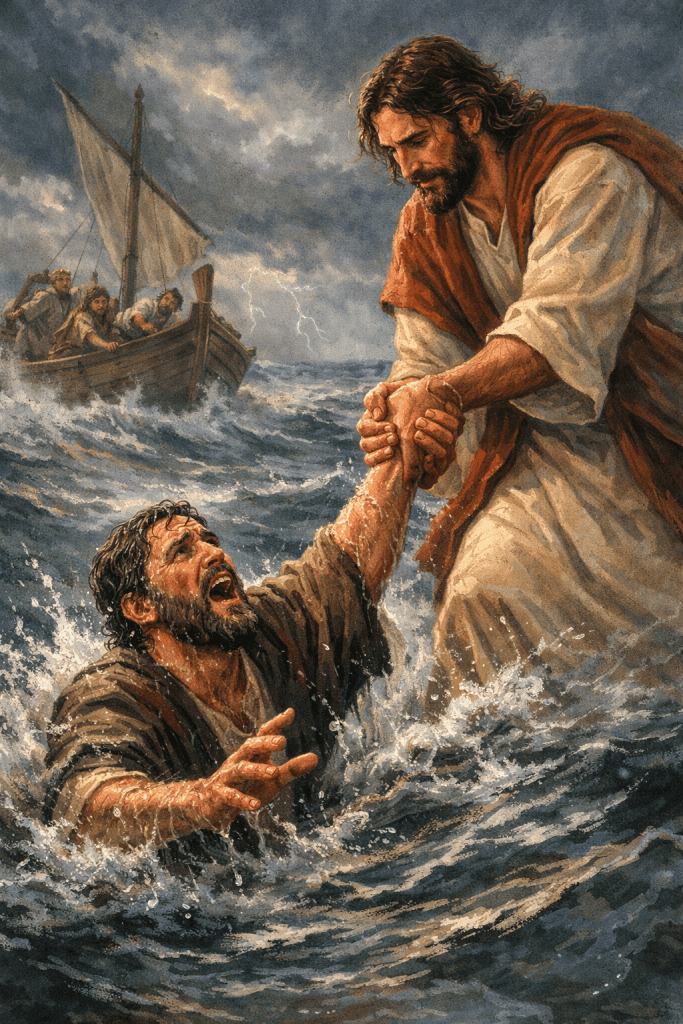
Yet Peter did the right thing in the wrong moment—he prayed. His prayer was short but powerful: “Lord, save me!”
Christ’s Grace
Immediately, Jesus stretched forth His hand and caught him. Grace was swift. Mercy was near. Deliverance was certain. Christ saved Peter, then gently rebuked him: “O thou of little faith, wherefore didst thou doubt?” The rebuke was not rejection; it was correction. The same hand that rescues also refines.
Conclusion
When Jesus and Peter entered the boat, the storm ceased. Christ could have walked directly to shore, but He chose instead to return with His disciples. His presence brought peace. Their fear turned to worship, and their confession rang clear: “Truly Thou art the Son of God.”
This passage asks searching questions of every believer:
Are we fair-weather Christians—faithful only when skies are clear?
Do we abandon obedience when storms arise?
Do we focus on waves instead of the Savior?
While we struggle on the tempestuous sea of life, Christ is on the mountain interceding for us. And in His perfect timing, He comes—sometimes walking upon the very troubles that threaten to overwhelm us. The call remains the same: Come. The question is whether we will trust Him enough to step out in faith.